Address
304 North Cardinal St.
Dorchester Center, MA 02124
Work Hours
Monday to Friday: 7AM - 7PM
Weekend: 10AM - 5PM

Address
304 North Cardinal St.
Dorchester Center, MA 02124
Work Hours
Monday to Friday: 7AM - 7PM
Weekend: 10AM - 5PM

Canada’s provision of advanced WESCAM electro-optical/infrared (EO/IR) sensor systems to Ukraine, part of Canada’s broader series of military donations to Ukraine, is a quietly transformative boost to Kyiv’s warfighting capability. In a conflict defined by drones, artillery, and attrition, high-end “eyes” in the sky often matter more than adding another tank or gun. Since 2022, Canada has committed over $296 million for these optics, delivering at least 140 WESCAM sensor units to Ukraine’s forces so far. This infusion of cutting-edge targeting cameras – from the battle-proven MX-15 and MX-20 turret series – gives Ukraine a new level of vision by day and night. It is a battlefield upgrade Moscow never wanted Ukraine to have, one that is already compressing kill-chains and exposing Russian units to precision strikes. Canadian-supplied WESCAM systems are being employed by conventional units and special operations forces in different ways, but with a common result: the erosion of Russian tactical concealment and a sharpening of Ukraine’s combat edge. This report assesses the tactical, operational, and strategic impacts of these sensors, contrasting their use in regular combined-arms warfare versus clandestine special operations, and examines how Russia is adapting (or failing to) under this enhanced Ukrainian surveillance. Crucially, it explains why providing superior optics is politically low-profile yet militarily high-impact – a form of support that exemplifies Canada’s outsized role in the conflict at a time when U.S. commitment can no longer be taken for granted. Key findings include:

The WESCAM MX-Series is a family of advanced multi-sensor, multi-spectral imaging and targeting systems originally developed in Canada by L3Harris WESCAM. These turret-shaped units – often seen as the spherical “eye” under the nose of a drone or helicopter – combine several powerful sensors in one stabilized package. At their core, WESCAM systems provide high-fidelity electro-optical (EO) and infrared (IR) imagery, laser targeting, and rock-steady stabilization, all integrated for real-time intelligence gathering and precision strike guidance. Key capabilities include:

On Ukraine’s conventional battlefields – from the trenches of Donbas to the broad steppes of Kherson – Canadian-supplied WESCAM EO/IR systems have become integral to combined-arms operations. Their impact is felt in nearly every facet of day-to-day combat for Ukraine’s regular forces. These sensors serve as the Army’s unblinking forward observers, the Air Force’s targeting pods, and the entire military’s nocturnal sentinels. Several key applications stand out:
Perhaps the most consequential use of WESCAM optics for conventional units is in artillery warfare. Ukraine faces an adversary that heavily employs tube artillery and rockets; countering those batteries has been a deadly game of cat-and-mouse. WESCAM-equipped drones have tilted that game in Ukraine’s favor. Using high-resolution thermal imagery and geo-coordinate spotting, Ukrainian forces can detect enemy artillery positions and destroy them with far fewer shots and far less delay than before.
For example, when a Russian howitzer battery opens fire, the muzzle flashes or the heat of recently fired gun barrels are picked up by a circling drone’s IR sensor. Within seconds, the WESCAM turret’s algorithms pinpoint the source coordinates. That data zips to a Ukrainian fire direction center, which can cue its own artillery onto the target almost immediately. Instead of laboriously ranging shots or relying on less accurate sound-ranging, the Ukrainian battery can often land a high-precision shell (such as a GPS-guided Excalibur round or laser-guided shell if a designator is on it) on the Russian guns after just one spotting round or none at all. Russian gun crews, who once could fire for several minutes before relocating, now find that staying in one spot for more than a minute invites deadly counter-fire.
This sensor-to-shooter linkage, enabled by WESCAM’s clarity and range, has greatly increased the lethality of Ukraine’s limited artillery assets. Every shell counts: with good eyes, a single Ukrainian gun can do what previously required a dozen bracketing shots. It also means Ukraine can use fewer guns to achieve the same effects, preserving barrels and ammunition in a war of attrition. There have been multiple documented cases of Ukrainian drones guiding counter-battery strikes that take out Russian Grad rocket launchers or heavy mortars moments after they reveal themselves. In essence, WESCAM optics have become the forward “spotter” for Ukrainian artillery across the front.
Conversely, these sensors help protect Ukrainian units from Russian artillery. Drones orbiting with thermal cameras can scan likely enemy firing positions (tree lines, village outskirts) and catch artillery units setting up. Ukraine can then strike first or force the enemy to displace. This proactive counter-battery effort, supercharged by Canadian optics, contributed to the significant reduction of Russian indirect fire density in areas where Ukraine gained air recon dominance. Russian gunners, knowing that unseen drones may be watching, are forced to shoot and scoot rapidly, often at the expense of accuracy and rate of fire. Moreover, if a Ukrainian position is shelled, WESCAM drones immediately survey the trajectory back to the source, enabling swift retaliation or at least marking the map for future action. In the duel of the “gods of war,” seeing the enemy clearly is half the battle – and Canada’s donation has given Ukraine exactly that ability.
Modern combined-arms doctrine talks about the “kill-chain” – the sequence of steps from detecting a target to engaging it with effect. Canadian WESCAM systems have helped Ukraine compress this kill-chain to lightning speed on the conventional battlefield. By having persistent eyes in the sky that are directly networked to shooters on the ground, Ukraine has achieved near-real-time targeting cycles in many tactical engagements. This is a profound change from how artillery and airstrikes worked in past conflicts (or for the Russians, who often still operate in a slower, more top-down manner).

Take a typical scenario: a Ukrainian battalion reconnaissance drone, flying several kilometers ahead of advancing troops, spots a Russian tank platoon hiding behind a treeline. In the past, the drone operator might radio the info up the chain, artillery would be called for, coordinates passed manually – a process that could take 20–30 minutes, by which time the tanks might move. Now, with a WESCAM MX-15 sensor ball providing a live video feed, that drone operator can instantly lase the target or mark it on a digital map. If artillery is prepositioned in range (as Ukraine’s often is in shoot-and-move mode), a fire mission can be initiated within a couple of minutes of first contact. If a strike drone or loitering munition is available, it can even be redirected in mid-air to hit the marked target. The result: a Russian tank that thought it was safely in defilade suddenly gets targeted by precision fire seemingly out of nowhere, all because a silent eye in the sky joined the dots in moments.
Such compressed kill-chains – sometimes referred to as “sensor-to-shooter loops” – have been especially effective in missions like hunting Russian air defenses. In the early phase of the war, Ukrainian Bayraktar TB2s famously destroyed several Russian surface-to-air missile systems (like Buk and Pantsir units) by catching them unprepared. This was possible because the TB2’s WESCAM sensor could spot the radar vehicle or launcher, identify it on video, and immediately launch a MAM-L missile guided by the sensor’s laser – all before the Russian crew fully realized they were being watched. Even as Russia got wise and started camouflaging or moving their SAMs frequently, Ukraine shifted to using multiple layers of sensors: a small quadcopter might flush out a SAM radar by drawing a reaction, then a higher-flying WESCAM-equipped drone pinpoints its location, cueing a HIMARS strike. The key enabler at each step is reliable, high-fidelity sensor data shared in seconds over the battlefield network.
In summary, Canadian optics have helped Ukraine move from the Soviet-style linear kill-chain to a dynamic, networked kill-web. Every WESCAM turret in the field is effectively a roving set of targeting coordinates that any shooter can access. This has compressed engagement times dramatically. Ukrainian officers have noted that some fire missions that once took 30 minutes of clearance and adjustment now happen in under 3 minutes if a drone sees a clear target. On defense, this means Ukrainian artillery can smash an attacking formation just as it assembles, rather than after it has begun its assault. On offense, it means when Ukrainian infantry encounters resistance, supporting fires (tube artillery, rockets, or drone strikes) can be brought to bear almost immediately on the exact source of resistance. This tight sensor-shooter integration – a hallmark of NATO doctrine – is something Ukraine has rapidly adopted, enabled significantly by the influx of Western sensor tech like WESCAM. It is no exaggeration that a Russian fighting in Ukraine now faces a kind of battlefield where if he can be seen, he can be killed within a very short window – a reality demoralizing to troops used to more opaque battlefields.
War doesn’t stop when the sun goes down or when the weather turns foul, and thanks to advanced EO/IR optics, Ukraine has ensured its fighting capability doesn’t either. Canadian WESCAM systems have greatly enhanced Ukraine’s night combat and bad-weather surveillance, denying the Russian forces the cover of darkness or elements that they once exploited.
In the cold months and long nights of Ukrainian winters, Russian units might assume they could maneuver or attack with relative impunity, as was often done in past conflicts. However, Ukraine’s thermal-imaging equipped drones now make the night perilous for the aggressor. A WESCAM sensor peering from 5,000 feet altitude can monitor a stretch of frontline in infrared, seeing the distinct white silhouettes of warm bodies creeping across snow or the hot exhaust plume of a truck convoy driving with lights off. Ukrainian defenders have repeatedly ambushed night assaults because an overhead EO/IR platform spotted the Russian troops forming up or moving through a dark ravine. In one instance during the winter fighting around Bakhmut, a Ukrainian drone operator detected a Russian infantry squad advancing through a treeline at 2 AM – their figures glowing on the thermal camera against the freezing background. Within minutes, Ukrainian mortars, guided by that drone’s eyes, broke up the assault before it reached the trench line.

Thermal vision has also been a game-changer in identifying targets amidst the clutter of war-torn urban or forested terrain. In destroyed cities like Mariupol or Sievierodonetsk (earlier in the war), combat often moved building to building. At night, Ukrainian units used drone IR sensors to scan ruins for hidden enemy fighters; a human body’s heat signature can stand out even behind a thin wall or blown-out window. Likewise, in heavily forested sectors of the front, Russian scouts sometimes attempted to crawl undetected; Ukrainian operators with Canadian thermal optics have spotted these “invisible” enemies by the contrast of their warmth against the cool ground. Thermal imaging cuts through many traditional concealment tactics – camouflage paint, foliage, or darkness – revealing what plain eyes would miss. Even in daylight, if the Russians popped a smoke screen to cover a retreat or to blind defenders, Ukrainian drones switch to IR mode, since thermal radiation passes through smoke better than visible light. The enemy’s heat outline remains visible, foiling the smoke tactic.
Adverse weather like rain and fog does degrade all electro-optics to a degree, but WESCAM systems, with their high sensitivity, can still provide useful imaging in conditions where unaided troops would be blind. Drizzle or light fog often isn’t enough to hide the thermal difference of vehicles moving (engines generate heat) on a cold morning. And while heavy rainstorms might ground some drones, Ukraine has a range of platforms – including some all-weather capable UAVs – to carry these sensors. There were cases where Russian forces tried to exploit low-cloud or mist at dawn for an operation, only to be detected by a persistent drone above the weather layer or by one flying low with IR picking out the contrast in temperature. The message is clear: neither nightfall nor bad weather guarantees safety from Ukraine’s view. This has strategic psychological impact too – Russian units cannot count on a “night holiday” from drone observation, forcing them to stay hunkered down or risk movement at all hours. By contrast, Ukrainian units, knowing they own the night in many sectors, have taken the initiative under darkness more often, staging night raids and recon patrols with confidence that they have the superior situational awareness. Canadian sensors have helped flip the traditional script – where usually the more technologically equipped side can conduct 24/7 operations while the other is limited – now Ukrainian conventional forces can operate continuously, and Russian units must worry that even in a blizzard, a silent eye might be watching their campfire’s glow.
In defensive operations, having early warning of enemy movements is life or death. The WESCAM sensors supplied by Canada have become a critical component of Ukraine’s early warning network along the front. High-flying drones with these EO/IR turrets serve as constant sentries, detecting Russian armored movements or troop concentrations well before they reach Ukrainian lines. This extended “visual horizon” has allowed Ukrainian defenders to prepare ambushes, call reinforcements, or reposition heavy weapons to meet attacks at the optimal place and time.

Consider Ukraine’s defensive success in repelling Russian armored thrusts in the open plains of the south. Much of southern Ukraine consists of wide, flat agricultural steppe with sparse tree lines – perfect terrain for tanks to maneuver, but also perfect terrain for drones to surveil. When Russia massed a battalion tactical group for a counterattack in Zaporizhzhia oblast, Ukrainian commanders had live drone feeds of their assembly areas. Thanks to sensors like the MX-20 (which has even longer range and higher altitude performance than the MX-15), Ukraine could watch enemy armor forming up 20–30 km away from the forward line. The moment those tanks and infantry fighting vehicles started rolling forward in attack formation, Ukrainian units were alerted via a common operating picture. Anti-tank crews moved into position, artillery laid on pre-registered fire zones, and reserve forces were readied – all before the Russians even made contact. By the time the attackers reached engagement range, they were walking into a prepared kill zone, pre-sighted by drones. In essence, WESCAM eyes gave Ukrainian defenders the gift of time and foresight, something traditionally gained only through human scouts or radar – but those sensors work through terrain or at shorter range.
Even in more constrained terrains like the wooded areas of the Siverskyi Donets or the outskirts of Kyiv (in the war’s early days), having a drone up with thermal optics meant any large movement of troops or vehicles would likely be caught. Ukrainian defenders famously decimated a Russian armored column at the Siverskyi Donets river crossing in May 2022 – reconnaissance drones spotted the bridging attempt and guided artillery with devastating effect. While not all details are public, it’s known that Western-supplied ISR (likely including thermal drone feeds) tipped off Ukraine to that maneuver, enabling a timely response. Today, Ukraine has democratized that capability across its brigades with Canadian-supplied cameras, rather than relying on sporadic satellite cues.
Additionally, WESCAM sensors contribute to overall situational awareness by continuous observation of no-man’s land. They catch signs of enemy activity that ground troops might miss – a glint of sunlight off a sniper scope in a building, fresh tire tracks to a previously empty field (visible from above), or a sudden lack of civilian traffic on a road (indicating the enemy closed it for a military move). All these subtle cues, when fed into Ukraine’s intelligence picture, help paint a more complete picture of Russian dispositions. In defense, knowledge is the ultimate high ground. Canadian optics have given Ukraine’s conventional forces a commanding view of the battlefield, literally and metaphorically, allowing them to be proactive rather than reactive against Russian offensives.
A critical, if less glamorous, benefit of these advanced sensors is how they help mitigate the brutal attrition of this war. By improving target discrimination and reducing the need for risky exposure, WESCAM systems are saving Ukrainian lives and material over the long haul. This is the cumulative effect of countless small advantages.

Firstly, precision targeting means fewer wasted rounds and fewer collateral damages. Every time a WESCAM drone confirms “yes, that heat source in the tree line is an enemy Grad launcher and not a farm tractor,” scarce ammunition is expended on real threats only. In a war of attrition, cutting out waste is like extending one’s ammo stocks and artillery barrel life. Ukrainian officers have noted that in periods when drone observation was hindered (due to heavy Russian jamming or lack of drones), their artillery units had to fire more shells per target and accept more guesswork – a luxury they cannot afford indefinitely. With reliable eyes, a single well-placed volley can replace ten speculative salvos. Over months of fighting, this preserves thousands of shells, meaning Ukraine’s firepower can be sustained longer. It also spares civilian infrastructure: better identification ensures that Ukrainian strikes hit actual military targets, not decoys or misidentified civilian objects, which is both a moral and practical win (avoiding alienating the population on whose territory this war is fought).
Secondly, having drones do the scouting keeps soldiers out of extreme harm’s way. In past eras, reconnaissance units would have to creep close to enemy lines, forward observers would hide on rooftops or hilltops to call artillery, and patrols would probe for enemy positions at great peril. Now, much of that dangerous work is offloaded to machines. A WESCAM-equipped drone can hover over a contested village and spot enemy machine gun nests, something that might have taken a platoon walking into an ambush to discover otherwise. By the time Ukrainian ground troops move in, they already know where the threats are (and often have dealt with them via an artillery or drone strike). This greatly reduces ambushes and surprises, which are major causes of casualties. In defensive scenarios too, rather than sending a squad to check on a strange noise in the dark, a commander can dispatch a small drone to scan the area – if it’s an enemy, they can engage appropriately, if it’s nothing, no lives were risked needlessly.
Another form of attrition mitigation is in countering Russian decoy and dispersal tactics. Russia, aware of Ukraine’s ISR advantage, has increasingly tried to use dummy targets (inflatable tanks, wooden artillery, etc.) or to spread real targets thinly to confuse reconnaissance. A high-grade EO/IR sensor can often tell a fake from real: a thermal camera will show an inflatable decoy tank as cold, whereas a real tank’s engine and exhaust would shine bright; a high-res day camera might notice lack of shadow or tracks around a dummy. Ukraine has in several instances struck what turned out to be dummy targets, but with experienced drone operators and analysts, those instances have dropped – one reason Russia’s decoy strategy hasn’t significantly reduced Ukraine’s strike success rate. So Canadian optics indirectly help Ukraine avoid wasting precious missiles on bouncy castles and painted plywood.
Lastly, consider exposure to enemy fire. Every time a Ukrainian unit can engage from standoff (thanks to coordinates from a drone) rather than having to slug it out within line-of-sight, that unit’s survivability increases. For example, Ukrainian tanks now often rely on drone spotting to snipe at Russian armor from positions of cover, without poking out their turrets for direct line-of-sight. The drone sees the target over terrain, the tank fires in an arc (if using guided or data-linked rounds) or uses ranging data. Similarly, small units can call accurate artillery on a machine gun nest instead of assaulting it head-on. Over months of grinding warfare, this preservation of manpower by using sensors as the first line of contact adds up. It is no coincidence that Ukraine’s military leadership has heavily emphasized acquiring ISR assets – they recognize that every drone and camera is effectively a soldier that doesn’t have to die to gain information.
In sum, across open fields, ruined cities, and dense forests alike, Canadian WESCAM EO/IR systems have become indispensable to Ukraine’s conventional war effort. They enable Ukrainian forces to see farther and clearer, shoot faster and more precisely, fight at night and in bad weather, and do all of this while limiting their own losses. On a battlefield where the side that sees first often shoots first, these “Made-in-Canada” eyes are quietly saving the lives of Ukrainian soldiers and helping wear down the Russian Army in a way that brute force alone could not.
While conventional units reap great benefits from WESCAM optics, Ukraine’s special operations forces (SOF) and partisan elements exploit these tools in distinct and innovative ways. For elite teams operating behind enemy lines or in high-stakes missions, information and stealth are as vital as firepower. Canadian-supplied EO/IR systems have given Ukraine’s special operators a dramatic boost in both surveillance capabilities and target acquisition, fundamentally changing how they conduct irregular warfare. In the shadows where SOF operate, the clarity of a WESCAM sensor can mean the difference between a successful raid and a lost team. The following are key applications of these systems in the special operations realm:
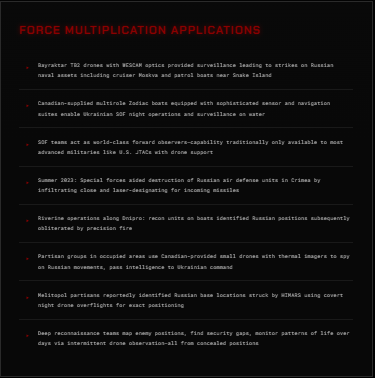
Ukrainian SOF are renowned for their ability to slip behind enemy lines, gather intelligence, and sabotage key targets. Traditionally, such deep reconnaissance relies on painstaking stealth and human observation – soldiers crawling up to vantage points with binoculars or setting up covert observation posts. Now, advanced sensors are amplifying what a handful of operators can achieve. Special forces now often bring along small unmanned aerial vehicles outfitted with high-grade EO/IR cameras (including scaled-down WESCAM systems or equivalents) to conduct “over-the-hill” surveillance without exposing themselves.

Imagine a Ukrainian special reconnaissance team inserted near a Russian supply route at night. In the past, they might wait on a hillside, straining through night vision goggles to estimate convoy sizes or quietly infiltrating a rail yard to photograph a target. Today, they can launch a backpackable drone that quietly hovers several kilometers away, its infrared optics scanning the objective area. From a concealed position, the team watches a tablet feed showing, for instance, a Russian logistics depot’s layout – guards on patrol, vehicles coming and going, the telltale white shapes of fuel trucks in IR. They never have to creep within eyesight of the enemy. The drone’s WESCAM-derived sensor does the dangerous looking for them. This allows SOF to perform strategic reconnaissance (STRATRECCE) with far less risk. They can map out enemy positions, find gaps in security, and even monitor patterns of life (shift changes, etc.) over days, all via intermittent drone observation.
One notable example was reported around Kherson before its liberation: Ukrainian special forces operating on the occupied west bank of the Dnipro used small drones with thermal cameras to surveil Russian troop rotations and heavy weapons placements at night. This intelligence was relayed to Ukrainian regulars and used to plan the offensive that eventually forced a Russian withdrawal. The SOF teams themselves stayed hidden in marshland, avoiding direct firefights, but their drones roamed the skies, marking targets and confirming which trenches were manned. In effect, a handful of operators fixed an enemy force of thousands by being the eyes that directed larger Ukrainian strikes.
Crucially, the use of EO/IR drones means SOF can reconnoiter places that would be suicide to approach on foot, such as airfields deep in Crimea or heavily guarded command posts. There have been mysterious explosions and attacks far behind Russian lines – while many are attributed to partisans or long-range missiles, in some cases Ukrainian special units likely infiltrated and laser-designated targets or emplaced charges. Their success in doing so undetected can be partly credited to good intelligence preparation using these sensors. By knowing exactly where cameras, sentries, and obstacles are (from thermal scans and high-zoom video), they can plot a path of entry and exfiltration that avoids detection. Essentially, WESCAM-type eyes give them a real-time “radar” of enemy blind spots. This flips the paradigm – the hunter becomes the hunted: Russian bases in their rear have to wonder if a tiny Ukrainian drone is watching them from the dark, heralding a sudden strike or raid.
Special operations often function as eyes and ears for strategic strikes – confirming high-value targets and ensuring critical missions go off with precision. Canadian targeting optics are now an integral part of this process. Before Ukraine expends a precious long-range missile or conducts a risky sabotage mission, they want absolute confirmation of the target’s location and identity; WESCAM sensors provide that confirmation and even enable terminal guidance via laser designation.
For instance, consider Ukraine’s campaigns against Russian command-and-control nodes and ammunition depots in occupied territory. Human informants or signals intelligence might tip off the location of a hidden headquarters or an ammo stockpile in a factory. But raw coordinates can be stale or imprecise. Instead of launching a cruise missile blindly, Ukraine will dispatch a small SOF team or an intelligence unit with a drone to surveil the site. Using an MX-series camera from a standoff distance, they can verify if the target is present (Are there dozens of military trucks around? Do thermal images show the heat consistent with an ammo bunker? Is there movement suggesting a high-level meeting?). Such positive identification dramatically increases the success of subsequent strikes, ensuring valuable munitions aren’t wasted.
On several occasions, Ukrainian strikes have wiped out senior Russian officers or key infrastructure with uncanny timing and accuracy – for example, the pinpoint HIMARS strike on a Russian brigade command post in Kherson region in July 2022 that killed a group of senior officers. It’s very likely that advance eyes on the ground (or rather, in the sky) ensured those officers were present and congregated at that moment. Those eyes could have been a clandestine drone feed, enabled by Western-supplied optics that gave a clear view through a window or across a compound.
Moreover, WESCAM’s laser designation capability allows SOF to act as force multipliers in guiding weapons. If a team infiltrates within a few kilometers of a crucial bridge or radar installation, they can hide and let their drone quietly orbit overhead. When the time is right, they use the drone’s laser to mark the target – then a distant Ukrainian artillery battery or a loitering munition homes in on that laser point for a first-shot hit. During the summer of 2023, Ukrainian special forces reportedly aided in the destruction of several Russian air defense units in Crimea by sneaking in close and lasing them for incoming missiles. The Russians never saw the Ukrainians – only perhaps a brief glint of the laser if they had sensors, and then the explosion.
This synergy was also apparent in riverine operations along the Dnipro, where small Ukrainian recon units on boats identified Russian positions that were subsequently obliterated by precision fire. The SOF’s high-tech binoculars in those cases were likely a combination of handheld thermal viewers and drone feeds from Canadian cameras. Essentially, Ukraine’s best fighters are now equipped not just with rifles but with real-time ISR links to call in the big guns exactly where needed. This is a capability only the most advanced militaries in the world traditionally have (e.g., U.S. JTACs with drone support). Canada’s contribution has helped Ukraine field world-class forward observers and targeteers in its special units.
Ukraine’s special forces have also been active in the maritime domain – from daring raids on Russian-occupied oil platforms and coastlines in the Black Sea, to stealthy insertions across the Dnipro River in the south. In these operations, situational awareness is paramount, and WESCAM-type sensors have proven invaluable. Canada’s donation of multirole Zodiac boats, each equipped with sophisticated sensor and navigation suites, hints at how Ukrainian SOF are using EO/IR optics on the water to dominate night operations and surveillance.
Picture a midnight insertion of Ukrainian commandos to a Russian-held spit of land in the Dnipro delta. Their Zodiac inflatable, engines muffled, glides through the dark waters. The team isn’t blind, however – the boat’s mounted thermal camera (possibly a WESCAM MX-10 maritime model) scans the riverbanks and inlets. From kilometers away, they can spot the silhouettes of enemy sentries or a moored patrol craft by its warm engine. This allows the Ukrainians to choose an undefended landing point or postpone if an ambush awaits. The same camera can record and transmit what it sees to headquarters, providing live naval reconnaissance. During exfiltration, if pursued, the boat operators can use the IR sensor to navigate in total darkness (no lights) and still see obstacles and trailing enemies, giving them a safe, fast escape through mangroves or coastal shallows that Russians wouldn’t dare chase into at night.
In the Black Sea theatre, Ukraine has carried out strikes and recon on Russian naval assets and installations. Bayraktar TB2 drones – initially outfitted with Canadian WESCAM optics – famously helped target Russian ships early in the war (notably providing surveillance leading up to the strike on the cruiser Moskva, according to some reports, and definitely destroying several patrol boats near Snake Island). Those were essentially special operations in effect, even if using regular drones – small teams coordinating with strategic effect. The clarity and range of the WESCAM sensor allowed the TB2 to operate at standoff distance from Russian vessels (staying outside of ship-based air defenses) while still tracking and targeting them. Later, as Ukraine developed unmanned surface drones (naval kamikaze drones) to attack Russian ships in Sevastopol, ISR support was needed to locate targets and assess damage. It’s believed Ukrainian special units and partisans in Crimea supplied some targeting intelligence, likely augmented by covert drone overflights with EO/IR cameras to pinpoint where ships were docked or when they were most vulnerable.
Even partisan groups – irregular resistance in occupied areas – benefit from these tools. While not WESCAM turrets per se, smaller Canadian-provided “drone cameras” and training have filtered down to partisans who can launch their own quadcopters with thermal imagers to spy on Russian movements, then pass info to Ukrainian intelligence. For example, partisans in Melitopol reportedly helped identify a Russian base location which was then struck by HIMARS; how did they get such precise coordinates? Possibly by sneaking a small drone over it at night to get exact positioning – a capability enabled by the flood of Western small drones and cameras into Ukraine.
In essence, whether it’s a Navy SEAL-like raid on a coastline or an underground resistance cell in a city, the formula is the same: stealth plus situational awareness wins the day. Canadian-supplied EO/IR gear ensures Ukraine’s special operators have godlike situational awareness in the dark or over the horizon, tipping the odds heavily in their favor for any given mission.
Ukraine’s defense against Russia isn’t only fought by uniformed soldiers. There is a shadow war of intelligence agents, partisans, and proxy forces (like Belarusian or Chechen volunteers) who all contribute. The integration of WESCAM-level optics into this clandestine war has been a force multiplier. Covert intelligence-gathering efforts are now often meshed with real-time drone reconnaissance, creating an ISR network that feeds both conventional and unconventional operations.
For instance, Ukrainian military intelligence (HUR) might get word from a local partisan that a new Russian electronic warfare system has been set up in a village. Instead of risking the partisan to take photos (which could get him caught), HUR can deploy a small UAV from 10 km away to peek in, using a powerful zoom EO camera to verify the system type and its exact coordinates. The partisan just has to confirm the target when shown an image. This kind of remote verification protects the underground assets while giving the Ukrainian high command actionable intelligence. It’s known that Western allies have provided Ukraine with secure communications and surveillance kit to empower these networks – Canada’s contribution of high-res drone cameras fits into that larger picture by physically enabling the recon.
Additionally, Ukraine can direct proxy sabotage teams with live overwatch. If a group of anti-Russian dissidents inside Russia plans to derail a military train or blow up an ammo depot, Ukrainian handlers could monitor the target area with a stealth drone from across the border, feeding them updated info (like where guards are, or when a target vehicle arrives). This tight coupling of ISR and proxy action makes such operations far more effective. It reduces the guesswork and increases the success rate of daring missions, whether executed by Ukrainian SOF or friendly partisans.
One could view it as Ukraine extending a “sensor umbrella” even over enemy territory, via a mix of human and technical means. Canadian sensors play a big role because they provide the clarity and range needed for deep operations. Each WESCAM turret delivered is not just serving at the frontline – some have surely been allocated to special units and intelligence cells that rove and reposition as needed to stare at the enemy’s sensitive sites.
Of course, using such high-tech sensors in special operations comes with its own risks and required trade-offs. While WESCAM-equipped drones allow SOF to see without being seen (most of the time), there is always the chance of detection by Russian forces – especially given Russia’s improving electronic warfare and counter-drone measures. Ukrainian special operators have to weigh these risks carefully, and they have adapted tactics to mitigate them.
One risk is the electronic signature. Drones controlled via radio can be detected by Russian signal intelligence; a sneaky team could be triangulated if they stay too long transmitting. To counter this, SOF often use programed flight routes (so the drone doesn’t emit controllable signals constantly) or newer datalinks that are frequency-hopping and encrypted to avoid interception. Some operations likely use line-of-sight laser communicators for near-silent control of drones – technology Ukraine has been experimenting with. Another tactic is to hand off control: a special forces team might launch a drone, then have a more distant command post take over its feed via satellite relay, so the team can power down their gear and minimize local emissions while the drone does its job. All these methods aim to let the SOF reap the sensor’s benefit without giving themselves away.
There’s also the risk that if a drone is shot down or crashes during a secret mission, the hardware (possibly containing Western components) could fall into enemy hands, tipping them off or yielding intel. Ukraine has to be mindful of this with sensitive tech. We’ve already seen Russia recover fragments of Western drones and munitions and parade them. However, given the value, Ukraine appears willing to risk some of these assets for high-payoff missions. Thus far, the trade-off has been favorable – the enemy has suffered far more from Ukrainian drone-led SOF strikes than Ukraine has from any lost sensor tech.
Finally, logistics and training are a factor. Special operators need to be trained to use these complex sensors effectively and maintain them under field conditions. Canada and other allies have almost certainly provided training to select Ukrainian SOF on operating advanced drone systems and on leveraging the data they provide. There’s a learning curve: interpreting thermal images, coordinating with conventional forces while remaining covert, etc. Ukrainian units like the SBU’s Alpha Group or military intelligence’s special units have, by accounts, become adept at this, essentially merging traditional commando skills with high-tech drone piloting and intelligence analysis. This synthesis of guerrilla savvy and technological prowess is something relatively new in warfare, at least at the scale we see in Ukraine. It’s as if Ukraine’s SOF have become cyberpunk commandos – stealthy, low-profile on the ground, but with a digital situational awareness bubble around them fed by Canadian cameras, Western satellites, and custom Ukrainian software.
In conclusion, Canadian EO/IR sensors are not only benefiting Ukraine’s armored brigades and artillery batteries on the front; they are also fueling the stealthy war in the enemy’s rear. From directing raids in Crimea, to helping partisans sabotage railways, to guiding missiles onto key targets, these quiet Canadian “eyes” are an unseen but critical partner to Ukraine’s bravest and most clandestine warriors. In the annals of unconventional warfare, Ukraine’s integration of high-end ISR into special ops may well become a case study of how to fight a superior enemy by endless harassment, enabled by never-ending information. And Canada’s contribution will be remembered as a catalyst that made those daring operations a lot more doable.
The Kremlin did not take Ukraine’s newfound visual advantage lying down. As Ukrainian drones peering through WESCAM lenses began to orchestrate effective strikes, the Russians have scrambled to counter, spoof, or survive under this pervasive surveillance. Russia’s countermeasures span high-tech electronic warfare systems to low-tech camouflage nets and decoys. However, the efficacy of these efforts has been mixed at best. While Moscow’s forces have improved at knocking down drones and confusing sensors, they have not been able to fully negate Ukraine’s ISR supremacy. Here we assess the main Russian responses and adaptations since the mid-war period (roughly late 2022 onwards):
Russia boasts a formidable array of electronic warfare units developed since Soviet times, and they have leaned heavily on these to combat Ukrainian drones. Powerful EW systems like the Krasukha-4 and Borisoglebsk-2 were deployed to jam UAV control links and GPS signals. On paper, these truck-mounted systems can disrupt drones across many kilometers, interfering with both the radio command signals and the satellite navigation that many drones use. In practice, they have had some successes – particularly against the simpler, commercially based drones Ukraine uses en masse. Ukrainian quadcopters and some older model UAVs have frequently been lost or forced to land due to Russian jamming in intense electronic warfare environments like the Donbas front.
Against more sophisticated platforms like those carrying WESCAM turrets, results have been less decisive. The Bayraktar TB2, for example, is designed to resist jamming to an extent (with directional antennas and encrypted comms), but the Russians did manage to down several TB2s, likely through a combination of electronic and kinetic means. By mid-2022, Ukraine’s use of TB2s in strike roles had to be curtailed due to heavy Russian air defenses and EW creating denial zones. Instead, Ukraine shifted to using them more for reconnaissance where possible, or holding them back for carefully planned missions. This cat-and-mouse prompted Ukraine to introduce more small drones with WESCAM-level optics nearer the front (where EW coverage might be spottier) and to harden their drone links. NATO-standard communications gear and tighter emissions control have helped Ukrainian ISR assets survive; for instance, some drones now fly pre-programmed routes on autopilot, needing no control link for large portions of their mission – essentially becoming immune to jamming during that phase.
Russia also employed narrow-beam jamming and spoofing on specific detected drones. If a Russian unit spotted a Ukrainian UAV visually or via radar, they could direct portable jammers or even UAV-mounted jammers at it to break its control link. At least one type of Russian drone, the Orlan-10, has been used in triads where one Orlan carries an EW payload to jam other drones while its partners do reconnaissance. This layered electronic defense shows Russia’s recognition of how deadly Ukrainian drone-spotter combos are.
Nevertheless, these efforts have limitations. Continuous broad jamming also interferes with Russian communications and electronics, so they can’t blanket the whole front indefinitely without hindering themselves. Ukrainian forces have adapted by using shorter-range but numerous drones that slip in under EW umbrellas or by quickly exploiting any gap in jamming coverage. For example, when Russians turn off jammers to use their own radios (a necessity at times), Ukrainian drones dart in to collect intel or strike. It’s a deadly whack-a-mole for the Russians: the moment they relax, an enemy drone appears; if they keep full jamming up, their units become deaf and blind and vulnerable to other attack modes.
From an adaptation perspective, by mid to late 2023 Russia had clearly learned to prioritize anti-drone warfare. Practically every Russian battalion now has some kind of EW detachment or at least portable “anti-drone guns” (rifle-like jammers that can down a quadcopter by frying its link). They have also invested in systems like Shipovnik-Aero and Silok specifically to detect and disrupt small UAVs. These have forced Ukraine to be more tactical – flying higher-end drones at night when detection is harder, or using decentralized swarms where some drones might get jammed but others slip through. In the chess match of EW, Russia’s pieces are strong, but Ukraine, empowered by Western tech and its own ingenuity, has found ways to play around them.
On the physical side of things, Russian units have returned to age-old methods of avoiding detection: hide, deceive, decoy. The surge in Ukrainian thermal imaging prompted Russian soldiers to dig deeper, cover more, and attempt novel forms of camouflage.
Thermal blankets and “invisibility cloaks”: By 2024, reports emerged of Russian troops using special thermal camouflage ponchos – multilayered sheets meant to reduce the heat signature of a person or object. Some Russian assault units trying to approach Ukrainian positions at night donned these cloaks believing they could slip under the gaze of thermal drones. Unfortunately for them, cheap versions of this gear actually made them stand out in many cases. Ukrainian drone footage showed dark, cold blobs (the cloaks) moving against a warmer background; the contrast was unnatural and, ironically, easier to spot by a trained analyst. It turns out partial masking (e.g., a blanket over a torso but legs exposed, or a blanket that cools one side of a body more than the other) can create an obvious outline on IR – like a moving pixelated shadow. Russian troops have also been observed hiding under tarps or in makeshift “heat tents” whenever a drone buzzes overhead. While this can work if done perfectly (and if they stay still enough to be indistinguishable from surrounding temperature), perfection is rare on a dynamic battlefield. Ukrainian units have cheekily nicknamed some of these attempts “ invisibility cloaks of shame,” noting how many failed instances led to drone-guided attacks wiping out groups of blanket-covered soldiers who likely thought themselves safe.
Vehicle and position camouflage: The Russian army did start taking camouflage netting and decoys more seriously after suffering losses to UAV-guided strikes. They deployed a lot more decoy equipment – inflatable tanks, plywood S-300 missile launchers, fake radar dishes – hoping to draw Ukrainian fire. In some instances, this worked for a shot or two until drones or satellite confirmed the mistake. More effectively, Russians began using multispectral camouflage nets (when available) over artillery and armor when idle. These nets attempt to reduce both visual and IR signature, making it harder for a drone to tell, say, a howitzer parked under a camo canopy from the surrounding brush. Again, quality matters: the best nets (some come from European suppliers that Russia can’t easily get now) can truly reduce thermal signature by blending it with ground temperature, but the more common stuff is hit-or-miss. The Ukrainians, in response, adjusted their drone recon tactics: they look for secondary signs – tire tracks leading into a treeline (even if the vehicle is covered, the tracks give away its presence), or smoke plumes from generators and kitchens in a camouflaged camp, or the outline of a net that might stand out slightly against natural backgrounds. It’s a cat-and-mouse where each concealment measure forces Ukraine to refine its detection techniques.
Underground movement and dispersion: To evade constant drone surveillance, Russian forces also adapted by moving in smaller groups and at times literally going underground. In heavy shelling zones, Russian troops dug extensive trench networks with covered dugouts to shield from aerial eyes. Before major moves, they often wait for bad weather or night (though as we covered, that’s no guarantee against IR drones). Armored units shifted tactics to more night driving without lights, short dashes from cover to cover, and longer halts under tree lines or within towns (using buildings to obstruct overhead view). Russia’s hope was to avoid presenting large, easily detectable concentrations that Ukraine could spot and annihilate. This has had some effect: the grand armored thrusts of early war (large convoys on open roads) are gone, because they’d be slaughtered by the modern ISR-directed fires. However, dispersing and hiding also slows and complicates Russian operations. It makes control and coordination harder for them, potentially contributing to the often noted lack of Russian momentum in offensives by 2023/24 – they simply can’t mass openly without attracting precision chaos from above.
The Russians have tried to fight back in the information domain as well, attempting to confuse Ukrainian/intel targeting decisions. One approach has been an increased use of decoy signals: for instance, setting up radio emitters or electronic signatures that mimic a headquarters or artillery battery, to lure Ukrainian strikes to the wrong spot. Without visual confirmation, such tactics could mislead purely electronic surveillance. However, with abundant drones, Ukraine often double-checks with an EO/IR eye. A suspected command post emitting lots of radio traffic might get a visit from a high-flying drone to see if antenna masts, vehicles, and tents are actually there. When a site “looks empty” despite electronic signatures, Ukraine wisely withholds fire. Thus, Russian attempts at electronic decoys have only occasionally succeeded, and likely less so as Ukraine grows wise to them.
Another adaptation: after suffering from targeted strikes on ammunition depots (which would light up like bonfires on IR when cooking off), Russia started breaking down large depots into many mini-depots spread around, and storing ammo in hardened sheds or deep underground whenever possible. This means a single drone finding one stash and calling a strike might only eliminate a fraction of what previously would have been a massive cache explosion. Strategically, this complicates Ukraine’s campaign to starve the front of ammo, but tactically it also slows Russia’s logistics having to shuttle between more sites. Again, an adaptation born of necessity that carries its own cost.
Russia’s propaganda also tried to downplay the effect of Western sensors, possibly to keep troop morale. State TV might claim that NATO is directly operating all these drones (implying Ukrainian success is only due to foreign help), or conversely claim their new anti-drone lasers or “wunderwaffe” have made Western tech useless. None of that changes reality on the ground, but it’s an attempt to mitigate the psychological edge Ukraine has gained – Russian soldiers know they are being watched by an unseen enemy nearly all the time. POW interrogations have revealed how demoralizing it is for them to feel “the Ukrainians see everything we do.” That constant stress wears units down. The Russian command has tried rotating units more frequently out of front lines to cope with drone-induced stress, an adaptation of sorts to preserve force mental health. But as long as Ukraine dominates the skies with sensors, Russian troops will remain under that mental pressure.
Looking forward, Russia may take further steps to counter improved Ukrainian ISR. One possibility is seeking external help to field better counter-drone systems or even better drones of their own. If China were to quietly supply more advanced EO/IR payloads or counter-ISR tech, that could shift dynamics in specific battles. So far there’s no sign of Chinese military-grade drones in Russian service (only commercial parts), likely due to political risks for Beijing. Iran has provided drones but even those like Mohajer-6 ended up revealing Western components and didn’t best Western sensors in quality. Still, Russia could escalate by dedicating more of its remaining air force to drone hunting – there were instances of Russian fighter jets patrolling to ambush Ukrainian UAVs (one reason high-profile TB2 usage decreased – they got shot down by fighters when operating near contested airspace). However, using expensive jets and risking pilots to chase relatively cheap drones is a losing proposition long-term (a $40 million Su-35 hunting a $200k drone is not a good tradeoff if ground-based solutions exist).
One dangerous escalation path is striking at the source of these sensors – not just shooting drones, but possibly trying to destroy the supply chain or the external support enabling them. We saw Russia attempt cyber attacks on Western satellite networks, and they’ve no doubt contemplated covert sabotage of arms supply routes. Canadian WESCAM production facilities, or the transport hubs through which these systems pass, could theoretically become targets of Russian covert operations or sabotage. So far, we haven’t seen any concrete action like that, possibly due to fear of NATO retaliation and the complexity of operating in North America or Western Europe. But as the war drags on, if Russia grows more desperate and convinced that Western ISR is the true linchpin of Ukrainian success, they might take riskier moves to blunt it – for instance, attempting to jam NATO surveillance assets like AWACS or Global Hawks in international airspace (there were a few incidents of Russian jets harassing U.S. drones over the Black Sea). Such moves edge close to direct conflict with NATO, which Russia has so far tried to avoid, but the more they feel cornered by Ukraine’s NATO-enabled lethality, the more they might test those boundaries.
In summary, Russia’s countermeasures have certainly made Ukraine’s life harder – the skies are not an uncontested playground, and Ukrainian drone operators face constant danger. But none of Russia’s adaptations have restored the kind of near-immunity from observation they enjoyed in the war’s first weeks (when Ukrainian ISR was sparse). Russian units continue to be caught and punished by Ukrainian “eyes,” albeit at a somewhat lower rate than when they were completely naive to the threat. The conflict is now one of move and countermove: drones versus jammers, camouflage versus thermal, decoys versus analysts. This is a defining feature of modern peer-ish warfare, and both sides are writing the playbook in real time. Thanks in large part to Western aid like the WESCAM systems, Ukraine is staying one step ahead in this battle of wits and tech. For the Russians, short of some breakthrough like effective anti-drone directed energy weapons (which remain in prototype stages) or overwhelming numerical superiority in the air (which they’ve not risked), their adaptation can only mitigate, not eliminate, Ukraine’s ISR advantage. Ukrainian forces, with Canadian optics in hand, continue to see clearly, and thus to strike true, keeping Russia on the back foot.
The infusion of Canadian WESCAM EO/IR sensors into Ukraine’s war effort carries implications that extend beyond immediate tactical gains. Strategically, it highlights a shift in how advanced military aid can influence a conflict’s trajectory without the fanfare – or provocation – of heavy weapons deliveries. This is an aid story that is politically quieter but militarily sharper than high-profile transfers like tanks or fighter jets.
For one, the success of these optics underscores a fundamental truth of modern war: information dominance can outweigh raw firepower. By giving Ukraine “better eyes,” Canada and NATO have enabled Ukrainian guns, drones, and missiles to hit as effectively as an army many times its size. This soft power approach – empowering the local force through superior ISR – achieves effects disproportionate to the material supplied. Politically, sending cameras and sensors does not trigger the same alarm bells as sending, say, Western combat aircraft. There were no dramatic red lines proclaimed by Russia when Canada announced nearly $300 million for imaging systems, in contrast to the saber-rattling we saw around proposals to send fighter jets or longer-range ATACMS missiles. In effect, Western donors found a sweet spot: optics transfers fly under the diplomatic radar even as they grievously undermine Russia’s ability to wage war. This suggests that in future conflicts, supporting allies with high-tech enablers may face less international pushback than overt lethal aid, yet yield equal or greater battlefield advantage.
NATO’s role in Ukraine has also evolved into that of an ISR enabler rather than a direct force provider. Instead of enforcing a no-fly zone (which was debated early and deemed too escalatory), NATO members are ensuring that Ukraine has an “all-seeing eye” over its own skies. This reflects a broader strategic doctrine: bolster the partner’s capacity to fight effectively on their own, rather than intervene directly. It threads the needle between helping Ukraine defend itself and avoiding a direct NATO-Russia shooting war. Canadian WESCAM units, along with U.S. satellite intel and European training, exemplify how NATO can be deeply involved in shaping battlefield outcomes without a single alliance soldier firing a shot. This has implications for NATO’s deterrence strategy – it shows a model of assistance that could be replicated if, say, an ally in Asia needed support against aggression. Providing the sensors, intelligence, and integration know-how allows the supported nation to do the actual fighting, maintaining the veneer of a local war even as global powers tilt the scales.
Of course, this approach raises questions about thresholds of involvement. At what point does enabling targeting cross into co-belligerence? Russia has accused NATO of being “almost a direct participant” due to the sharing of real-time targeting intelligence. The West has countered that providing information or hardware is not the same as pulling the trigger. This fine line appears to be holding in Ukraine: Russia has largely accepted Western ISR support as a reality it must counter, reserving its harsher rhetoric for things like potential Western troop deployments or game-changing strike weapons. The use of Western optics doesn’t carry the psychological or political weight of, for instance, NATO fighter jets shooting down Russian aircraft, but it achieves many of the same aims by letting Ukrainians shoot down those aircraft (or destroy them on the ground) themselves.
For Canadian nationalism and policy, this episode is likely to be held up as a point of pride. At a time when the United States has swung between strong support for Ukraine and voices of skepticism or distraction (given its internal politics), Canada stepped in with a niche capability that markedly boosted Ukraine’s effectiveness. It’s a reminder that smaller NATO countries can make outsized contributions by supplying critical specialties. Canada’s steadfast support – from winter uniforms to optics – plays to its strengths (extreme cold gear, advanced tech from companies like WESCAM) and signals reliability. In an era of unpredictable U.S. politics (where one election could hypothetically curtail American aid), such reliable allies become linchpins for sustaining Ukraine and deterring Russian escalation. Strategically, the message to adversaries is that the West’s support is broad-based and tech-savvy: even if one partner wavers, others can fill the gap with quality, not just quantity.
On the battlefield evolution side, the use of high-end optics by a non-superpower military (Ukraine) against a supposed peer (Russia) is forcing military thinkers worldwide to reconsider doctrines. We are seeing previewed in Ukraine what a future peer conflict might look like: dense ISR coverage, lethal precision strikes on anything that moves, and a premium on counter-ISR tactics. One lesson is clear – no force can expect to maneuver freely or concentrate in the open under modern surveillance. Camouflage, dispersion, electronic countermeasures, and deception will become even more crucial in any NATO-Russia or U.S.-China scenario. The Ukraine war has become a testing ground for these concepts, and Western militaries, including Canada’s, are surely studying how their donated systems performed. There will be insights such as: How many optical assets are needed per brigade for optimal coverage? What maintenance and training issues arose in sustaining them? How well did allied networks integrate with a local force under live conditions? These lessons can inform NATO’s own preparations.
Finally, there’s the aspect of escalation management. The quiet nature of optics aid has proven that not every significant military contribution triggers uncontrollable escalation spirals. Russia grumbled about Western satellite help and ISR, but ultimately Moscow has had to adapt on the battlefield rather than expanding the war. This could encourage more bold support in similar lines – e.g., more advanced drones, more integrated data-sharing – without undue fear that it will cross some imaginary threshold. The threshold seems more tied to physical Western forces or NATO-branded major offensive weapons. Optics are neither; they’re defensive in appearance (they don’t kill by themselves) yet offensive in effect. That duality made them a diplomatically palatable yet militarily potent aid category.
In summation, the strategic implications of Canada’s WESCAM support to Ukraine highlight a new paradigm of warfare and alliance assistance: wars can be decisively influenced by the side with superior battlefield awareness, and a coalition can supply that awareness stealthily. Ukraine’s successes born of this support will likely shape alliance thinking – the idea of an “ISR coalition” supporting a partner might become as standard as, say, a logistics coalition or an airlift coalition. And for Russia and others, the war underscores a sobering fact: to challenge NATO or its partners in the future, one must first survive the glare of their sensors. High-tech optics have become as strategically significant as jets and tanks, even if they don’t make the news headlines. The battlefield of the 21st century will be lit not just by muzzle flashes, but by lasers and infrared beams invisible to the naked eye – and those may decide who prevails.
This report is based on open-source intelligence (OSINT) and observable data up to late 2025. The confidence in certain findings varies:
Confirmed Data (High Confidence): It is well-documented through official releases and credible defense reporting that Canada has supplied at least 140 WESCAM EO/IR sensor units to Ukraine since 2022, including MX-15D and MX-20 systems. The capabilities of these systems are known from manufacturer specifications and prior use in other conflicts. Numerous battlefield videos and accounts confirm that Ukrainian forces have employed advanced drone-mounted cameras for artillery spotting and strikes (for example, TB2 strike footage with WESCAM HUD overlays was observed in 2022). Russian adaptation measures like increased EW jamming, use of decoys, and thermal cloaks have been reported by multiple independent sources (including satellite imagery analysis and ground reports). Thus, the general impact – that Canadian optics improved Ukrainian ISR and that Russia had to react – is solidly supported by available evidence.
Probable Assessment (Moderate Confidence): The differentiation between conventional and SOF use cases is drawn from patterns and some anecdotal reports. We have moderate confidence that Ukrainian SOF are using these or similar sensors for recon and target designation, given reports of their successes behind lines and the known provision of drone technology to special units. However, direct OSINT confirming “WESCAM X was used by SOF unit Y in operation Z” is understandably sparse due to operational secrecy. The assessment that WESCAMs have dramatically compressed kill-chains is grounded in logical inference and some documented instances, but we lack quantitative data (Ukraine understandably doesn’t publish detailed after-action timelines). Operational outcomes like the degree to which Russian offensive capacity was blunted specifically by these sensors versus other factors are complex to isolate – the report attributes a significant role to sensors with medium confidence, aligning with expert analysis but not definitively proven in isolation.
Speculative Elements (Lower Confidence): Some forward-looking statements (e.g., how Russia might further escalate, or how exactly NATO will incorporate these lessons) are speculative. We flag that predicting adversary decisions or long-term strategic shifts has uncertainty. Likewise, while there are reports of Russian morale issues due to drones and cases of failed thermal camouflage, we cannot measure how widespread or uniform these phenomena are across a front of 1000+ km – such qualitative observations may not hold everywhere at all times. The exact tactics of Ukrainian SOF remain classified; our depiction is an informed construction based on limited released info and known capabilities. It should be understood as representative rather than exhaustive.
Intelligence Gaps: Key unknowns include:
In compiling this report, we encountered the typical fog of war that surrounds fast-evolving conflict dynamics. The information from 2022-2023 operations is much clearer in hindsight now than it was in the moment, but some details may still surface later that adjust our understanding (for example, a debrief revelation of a particular operation’s ISR component). We have aimed to highlight areas of high confidence and clearly label analytical leaps.
Overall, the narrative – that Canadian EO/IR assistance provided Ukraine a significant ISR edge and that this edge materially influenced the conduct of the war – is supported by convergent evidence and widely accepted among military observers. However, as with all aspects of this ongoing war, new information can emerge. Analysts will need to watch for:
In conclusion, based on what OSINT can presently tell us, the Canadian WESCAM optics have proven to be a quietly revolutionary aid, though some fine-grain details of their use remain shadowed by operational secrecy. Future disclosures and post-war analyses will hopefully fill in those gaps, but until then, our assessment rests on a strong foundation of observed outcomes and expert reasoning about the capabilities in play.
 America’s Collapse Is Not a Canadian Tragedy—It’s a Canadian Reckoning
 Base Profile: Al Watiya Air Base (Libya) — How Turkey Rewrote the Rules of Air War
 Kharg Island and Trump’s Switch Gambit: The GPS War Nobody’s Covering, and Why the Oil Infrastructure Might Burn Anyway
 Saudi Arabia’s Vision 2030: How AI and Tech Investments Are Reshaping the Kingdom