Address
304 North Cardinal St.
Dorchester Center, MA 02124
Work Hours
Monday to Friday: 7AM - 7PM
Weekend: 10AM - 5PM

Address
304 North Cardinal St.
Dorchester Center, MA 02124
Work Hours
Monday to Friday: 7AM - 7PM
Weekend: 10AM - 5PM
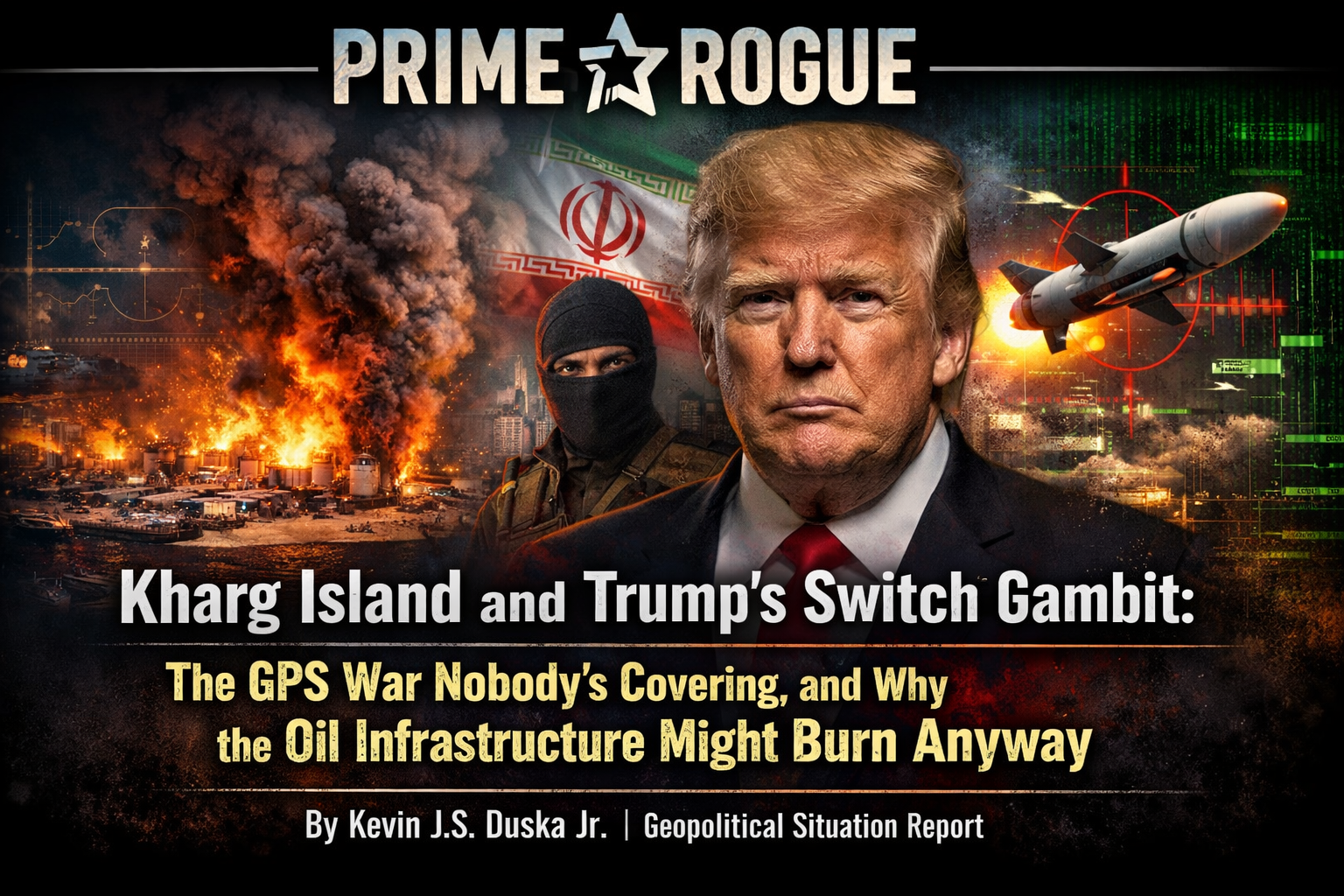
By Kevin J.S. Duska Jr. | Prime Rogue| Geopolitical Situation Report on Kharg Island March 14, 2026On the evening of Friday, March 13, 2026 — after the New York Mercantile Exchange had closed, after WTI crude had settled at $98.71 and Brent had crossed $100 for the second consecutive session, after the trading desks had gone dark and the algorithms had wound down for the weekend — Donald Trump posted on Truth Social.
"Moments ago, at my direction, the United States Central Command executed one of the most powerful bombing raids in the History of the Middle East, and totally obliterated every MILITARY target in Iran's crown jewel, Kharg Island."
Then came the sentence that mattered most: "For reasons of decency, I have chosen NOT to wipe out the Oil Infrastructure on the Island. However, should Iran, or anyone else, do anything to interfere with the Free and Safe Passage of Ships through the Strait of Hormuz, I will immediately reconsider this decision."
Two weeks into Operation Epic Fury, Trump had finally touched the one target everyone said was untouchable. And he did it after the markets closed, on a Friday, giving Iran the entire weekend to respond before a single barrel of oil would trade.
That timing is either the most strategically sophisticated market management move of this conflict. Or it is the most convenient architecture for what may be about to happen next.
This piece is about why those two possibilities are not mutually exclusive — and why the oil infrastructure on Kharg Island may burn regardless of what Trump says he intends.
What Is Kharg Island - Actually?Before getting into the strategic analysis, it's worth establishing just how significant Kharg Island is, because the coverage has underplayed it.
Kharg is a five-mile-long coral island in the northern Persian Gulf, approximately 25 kilometers off the Iranian mainland. It is not famous. It is not strategic in the way that Hormuz is strategic — it doesn't control a chokepoint, it doesn't command a strait. What it does is serve as the export terminal for roughly 90 percent of Iran's crude oil production. Everything Iran sells — to China, to India, to whoever is still buying — flows through the loading infrastructure on Kharg Island.
For context: Iran produces approximately 3.3 million barrels of oil per day. Roughly 1.5 million of those barrels are exported. JPMorgan analysts estimated this week that if Kharg's infrastructure went offline, as much as half of Iran's national oil output could be at risk from day one, with the regime's previously-assumed 20-day buffer "vanishing immediately."
For two weeks of Operation Epic Fury, Kharg was the one target the US and Israel left alone. Tehran, Isfahan, Qom, nuclear sites, IRGC headquarters, the navy, oil depots in Tehran — all hit. Kharg: untouched. Analysts read this as Trump's ultimate leverage card. The thing he holds back to force a negotiated exit. The implicit threat that keeps Iran calculating.
On March 13th, Trump cashed part of the card — hitting the military infrastructure while publicly, loudly, and very deliberately sparing the oil infrastructure.
That public declaration is the most important sentence of this war so far. And it is also, paradoxically, the architecture of maximum deniability for what comes next.
The Hostage Negotiation FrameworkLet's be precise about what Trump's Truth Social post actually is. It is not a victory announcement. It is a conditional threat with an explicit trigger.
The structure is: I have demonstrated capability and restraint simultaneously. I have hit everything military on your most valuable island. I have chosen not to destroy your economic lifeline. If you do X — interfere with Hormuz passage — I will destroy it.
This is not bombing. This is coercive diplomacy backed by demonstrated force. It is the kind of move that, in a rational-actor model, should produce exactly the outcome Trump wants: Iran calculating that the cost of continued Hormuz interdiction now includes the destruction of its primary oil revenue infrastructure, and therefore opening the Strait.
The problem is that Iran's decision-making is not currently operating in a rational-actor model. It is operating in a wounded-animal model. And the man making the decisions has no political room to be seen as the person who blinked.
Mojtaba Khamenei: The Decision-Maker Nobody KnowsThe single most important variable in this entire analysis is a person most Western audiences have never heard of.
Mojtaba Khamenei — son of the assassinated Supreme Leader Ali Khamenei — became Iran's new Supreme Leader under conditions that would make any political theorist wince. His father was killed on the first day of Operation Epic Fury. The Assembly of Experts, the constitutional body responsible for selecting a new Supreme Leader through a deliberate clerical consensus process, was bombed by Israel while in a preliminary session. Mojtaba was selected under fire, in chaos, by whoever was available.
His background is not that of a traditional Supreme Leader. He is not primarily a religious scholar or a revolutionary figure. He built his power base running intelligence operations inside the IRGC — the Islamic Revolutionary Guard Corps. He was the quiet hand behind some of the most brutal internal crackdowns of the last two decades, including the 2009 Green Movement suppression and the 2019 fuel protest killings. He is an intelligence operative who happens to be a cleric, and he came to power with zero traditional legitimacy credentials.
His first public statement as Supreme Leader made his position explicit: the Strait of Hormuz must stay closed, attacks on Gulf states hosting US bases will continue, the blood of the martyrs will be avenged.
As of March 13th, the Pentagon confirmed he has been wounded — likely disfigured — in a strike whose attribution remains unclear even to US officials. VP Vance told reporters "we know he's hurt, we don't know exactly how bad."
Think about that decision-making environment. A new, constitutionally-dubious, wounded leader of a country at war whose entire path to consolidated power runs through not losing. His political survival is not separable from his defiance. He cannot be the man who opened the Strait after the Americans bombed Kharg. That is not a man who is about to respond to coercive diplomacy the way the coercive diplomacy model assumes.
This is the flaw at the center of Trump's Kharg gambit. It assumes a rational cost-benefit calculation at the top of the Iranian state. What actually exists there right now is a survival calculation. Those produce different outputs.
The Invisible War: GPS Spoofing and the Half-Dumb Bomb ProblemHere is the part of the Kharg Island story that has received almost no coverage, and which is the most operationally significant element of the entire analysis.
Since Operation Epic Fury began on February 28th, Iran has been running one of the most aggressive GPS spoofing campaigns ever recorded in a commercial maritime environment. Maritime intelligence firm Windward tracked 21 new GPS jamming clusters appearing immediately after strikes began. The Joint Maritime Information Centre logged over 600 individual disruption events in a single 24-hour period. By early March, approximately 1,650 vessels in the Middle East Gulf and Gulf of Oman had experienced navigation interference — ships appearing on screens at airports, nuclear power plants, and miles inland. The Royal Institute of Navigation classified the situation as "unprecedented in scale for a commercial shipping context."
This is not background noise. This is active, state-level electronic warfare being conducted continuously across the exact airspace through which US cruise missiles fly to Iranian targets.
Tomahawk cruise missiles — the weapon Trump has repeatedly singled out by name as America's primary strike tool in this conflict, the weapon he specifically noted no other participating country uses — have a layered guidance architecture designed precisely for contested GPS environments. GPS is primary. When GPS is jammed or spoofed, they fall back to TERCOM: Terrain Contour Matching, which compares real-time radar altimeter readings against pre-loaded digital terrain maps. When TERCOM is insufficient, they fall back further to INS: Inertial Navigation Systems, which compute position through dead reckoning from a known start point.
Each fallback degrades accuracy. Under normal GPS conditions, Tomahawk CEP — Circular Error Probable, the radius within which 50 percent of strikes will land — is in the single-digit meters range. In GPS-denied environments relying on TERCOM and INS, published assessments put that figure at "tens to, in extreme cases, hundreds of meters depending on conditions."
Here is the specific problem with Kharg Island as a target environment for that degraded accuracy scenario.
TERCOM works by matching terrain features against pre-loaded maps. It requires topographic variation — hills, valleys, distinctive geographic features — to generate reliable matching data. Kharg Island is a flat coral strip in the featureless water of the northern Persian Gulf. It is precisely the kind of target environment where TERCOM performs worst. This is not speculation — the US military documented a nearly identical problem during the early stages of Operation Iraqi Freedom in 2003, when approximately ten Tomahawks drifted off course and crashed in Turkey, Saudi Arabia, and Iran because TERCOM couldn't match the featureless Iraqi desert terrain.
INS drift compounds this. Inertial navigation accumulates error over time. Even a high-grade INS system can accumulate hundreds of meters of error over a long flight in a GPS-denied environment. On a five-mile island where the distance between a military target and the oil export terminal may be measured in hundreds of meters, that drift is not an abstraction.
And there is a third factor that hasn't been mentioned in mainstream coverage at all: DSMAC — Digital Scene Matching Area Correlator, the optical terminal guidance system that helps Tomahawks acquire their exact aim point in the final seconds of flight. DSMAC matches the scene it sees against a reference image pre-loaded before launch. After two weeks of strikes across Iran — fires, smoke, structural damage, changed terrain signatures — the reference imagery for Kharg Island may bear increasingly limited resemblance to what the missile's optical sensor actually sees on approach.
The school in Minab on Day 1 of this war was, according to the DoD's own preliminary investigation, almost certainly struck by a US munition. The explanation offered was "dated intelligence" — targeting data that didn't accurately reflect what was on the ground. DSMAC operating against stale reference imagery is another version of exactly the same failure mode.
None of this requires malice. All of it is technically documented. All of it is operating right now in the airspace over the Persian Gulf.
The Accidental-On-Purpose ProblemThere is a scenario that has not been seriously discussed in mainstream coverage and which this analysis is going to put on the table directly.
The "accidental-on-purpose" strike on Kharg oil infrastructure.
The architecture is this: Trump publicly and loudly commits to sparing the oil infrastructure. This creates maximum deniability. A munition — degraded by GPS spoofing, operating in poor TERCOM terrain, running on DSMAC imagery that no longer matches the ground — drifts. The oil terminal burns. Trump says what he said about the school: I don't know about it. We're investigating. Iran did it.
The political incentive structure for this scenario is real, even if the operational execution would be unintentional. Consider who benefits from Kharg oil infrastructure going offline:
**Trump:** Gets the economic pressure on Iran he's been threatening without having to own the decision to cross his own publicly-stated red line. Gets to blame Iran or "fog of war." The domestic oil industry — already printing money at $98 WTI — benefits further.
**The IRGC:** Gets a propaganda victory and a legitimacy boost for Mojtaba Khamenei's defiant posture. Gets to say the Americans destroyed civilian economic infrastructure. Can point to it as justification for whatever comes next.
**Russia:** $150 million a day in extra revenue at current prices goes higher. Every barrel of Iranian export capacity that goes offline is a barrel Russia can sell at a premium.
The people who don't benefit: Iranian civilians, Asian economies dependent on Gulf oil, European consumers, the global shipping industry, and anyone who needs the price of food and fuel to not go vertical.
This is not a conspiracy theory. It is an incentive map. And it is operating in an environment where the technical conditions for an "accidental" strike on oil infrastructure are documented, present, and worsening.
The Munitions Problem Nobody's Talking AboutThere is one more layer to this analysis that the mainstream coverage has almost entirely missed.
The Financial Times reported this week, citing three sources, that the Trump administration has already burned through what officials described as "years" worth of some key munitions since Operation Epic Fury began. The report specifically flagged heavy use of long-range Tomahawk missiles. This was published quietly, got little traction, and is arguably one of the most strategically significant pieces of reporting of the entire conflict.
The Tomahawk production base is not a warehouse you can restock over a weekend. RTX — Raytheon — is the sole manufacturer. Contract data from Naval Air Systems Command shows procurement in batches of roughly 90 missiles. The upgrade program converting older Block IV missiles to more jam-resistant Block V variants was scheduled to run through 2029, meaning a significant portion of the current active inventory is older hardware with less electronic warfare hardening.
This creates a direct connection back to the GPS problem. If the munitions inventory is constrained, and if the newer Block V missiles — the ones with better anti-jam capability — are being prioritized for high-value targets, what's flying toward secondary targets like the military infrastructure on a coral island in the northern Persian Gulf? Potentially older Block IV hardware. Less hardened. More vulnerable to the exact GPS spoofing environment Iran is running.
Trump said last week there are "practically no targets left to strike." That may be more literally accurate than he intended. And if the coercive threat against Kharg oil infrastructure requires follow-through munitions that are running low, the pressure to act — one way or another — before the inventory depletes further is real.
The Market Timing TellOne element of the March 13th announcement deserves specific attention that it has not received.
Trump announced the Kharg Island strike at 7:05 PM Eastern Time on a Friday. NYMEX had been closed for over an hour. Brent crude had settled at $103.14. WTI had settled at $98.71. After-hours trading moved approximately 30 cents — thin volume, algorithmic noise, not a signal.
The first real market reaction to the Kharg strike will be the Sunday night futures open, followed by the Monday morning Tokyo open.
This means: the most consequential strike of this war, with the most direct connection to global oil infrastructure, was announced in a window that gives the market zero ability to react in real time, and gives Iran the entire weekend to respond before prices move.
If Iran retaliates conventionally this weekend — more ship attacks, more Gulf strikes — Monday oil opens up, markets price in stalemate, and the political pressure on Trump to follow through on the Kharg oil threat increases.
If Kharg oil infrastructure burns this weekend, for any reason — Monday oil opens at a price that hasn't been seen since the 2008 financial crisis, with the IEA's 400-million-barrel reserve release already largely committed.
If Iran signals willingness to negotiate on Hormuz — Monday oil drops hard, Trump claims total victory, and we find out what the endgame actually looks like.
Three scenarios. Three completely different market outcomes. All of them hinge on decisions being made right now by a wounded man in an undisclosed location in Iran who has no political room to back down.
What to WatchThis is not a story that resolves over a weekend. It is a story that enters its most dangerous phase over a weekend. Here is what to monitor:
**The Kharg oil infrastructure.** Satellite imagery will show within hours if anything burns. Planet Labs and Maxar both have regular passes. If smoke appears over the loading terminals on the northwest side of the island, the entire analysis above becomes a news story, not a forecast.
**Mojtaba Khamenei's status and next public communication.** A wounded, newly-installed Supreme Leader who goes silent for 48 hours after the Kharg strike is a different signal than one who appears publicly. Watch for IRGC statements as a proxy for his operational control.
**Sunday night futures.** CME Globex opens at 6 PM Eastern Sunday. The first print will tell you how institutional money is reading the weekend's events before any analyst has filed a piece.
**CENTCOM statements on munitions and strike tempo.** Watch for any language about "transitioning to a different operational phase" or "consolidating gains" — these are the linguistic tells for a drawdown that can't be publicly framed as a drawdown.
**Iranian strikes on Kharg specifically.** If Iran hits its own oil infrastructure in a retaliatory attack, watch the attribution debate very carefully. The "we were targeting US military positions" framing is already in their playbook.
The Bottom LineTrump's Kharg Island strike is the most strategically complex move of Operation Epic Fury. It is simultaneously a demonstration of capability, a coercive threat, a piece of domestic political theater, and — in the GPS-jammed, munitions-depleted, TERCOM-hostile environment of the northern Persian Gulf — an accident waiting for a technical pretext.
The oil infrastructure on Kharg Island was not destroyed on March 13th. Whether it survives the weekend is a question whose answer depends on the intersection of a wounded new Supreme Leader's political calculations, the reliability of aging cruise missile guidance systems in a spoofed GPS environment, and whether someone in the chain of command — Iranian or American — decides that ambiguity serves their interests better than restraint.
Follow the money. Follow the smoke. And watch the Sunday night futures print.
---
Kevin J.S. Duska Jr. is President of Prime Rogue Inc., a Calgary-based private intelligence and strategic transparency firm. He covers geopolitics, intelligence, and accountability across multiple investigative verticals.
Related coverage: Signal Cage | AI Weapons Watch |
 The Detour Doctrine: Why Canada and Mexico Are Replacing U.S. Trade Infrastructure
 Quietly Reshaping the Battlefield: Canadian WESCAM Optics in Ukraine’s War
 Base Profile: Al Watiya Air Base (Libya) — How Turkey Rewrote the Rules of Air War
 ISR: The Eyes of a Dying Empire: How America Watched the World Burn—One Thermal Feed at a Time