Address
304 North Cardinal St.
Dorchester Center, MA 02124
Work Hours
Monday to Friday: 7AM - 7PM
Weekend: 10AM - 5PM

Address
304 North Cardinal St.
Dorchester Center, MA 02124
Work Hours
Monday to Friday: 7AM - 7PM
Weekend: 10AM - 5PM
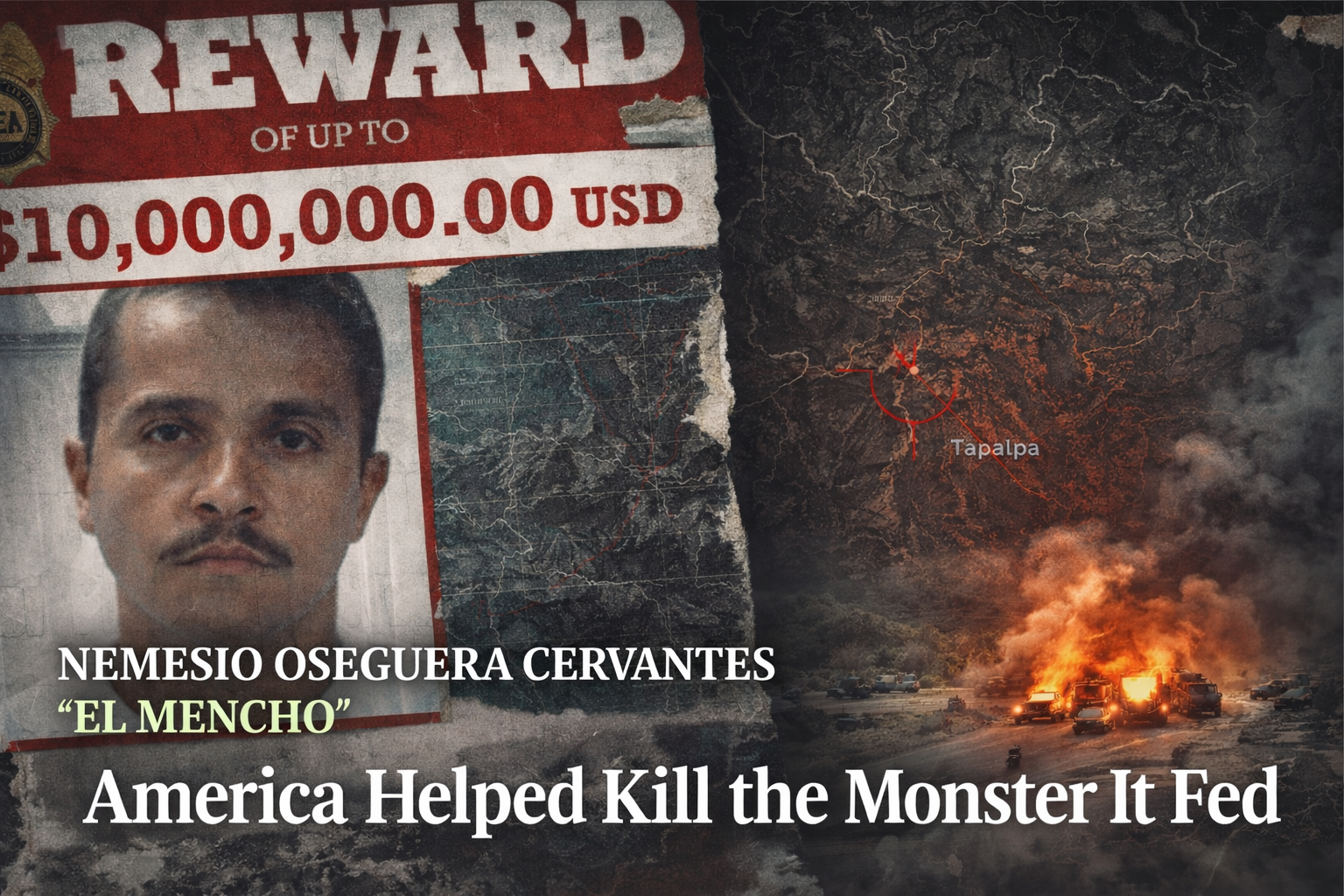
The Mexican Army killed the most powerful drug lord on the planet this morning in a mountain town in Jalisco, and the United States helped pull the trigger. Nemesio Oseguera Cervantes — “El Mencho,” founder and supreme commander of the Jalisco New Generation Cartel — was wounded during a Special Forces raid in Tapalpa and died while being airlifted to Mexico City. Within hours, his cartel set half of western Mexico on fire. Burning vehicles blockaded highways across at least nine states. Armed men on motorcycles besieged Puerto Vallarta. An active shooter situation erupted at Guadalajara’s international airport. The U.S. Embassy told Americans in five states to shelter in place and not move.
This is, by every metric, the biggest scalp taken in the drug war since Joaquín “El Chapo” Guzmán was dragged out of a sewer tunnel in 2016. Mexico’s Defense Secretariat — in language that will be parsed for years — confirmed that U.S. authorities provided “complementary information” for “the execution of this operation” within a framework of “bilateral coordination and cooperation.” A Pentagon official told CBS News the U.S. military “played a role” through the Joint Interagency Task Force–Counter Cartel, a unit established barely five weeks ago under U.S. Northern Command. The CIA has been flying MQ-9 Reaper drones over Mexican airspace since at least early 2025.
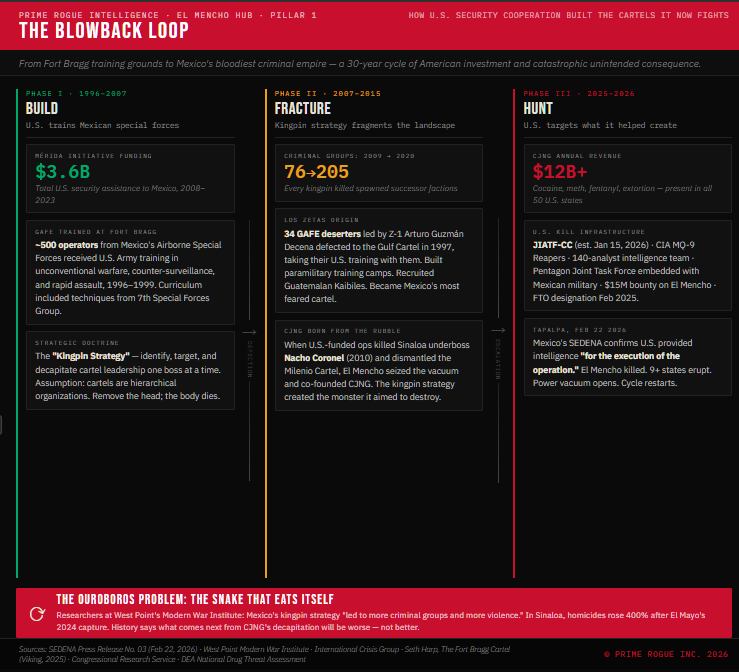
Here is the part nobody in Washington or Mexico City wants to say out loud: the United States spent decades and billions of dollars building the security architecture that created the conditions for CJNG to exist — and then spent billions more trying to destroy what it helped create. U.S. Special Forces trained the Mexican commandos who deserted and became Los Zetas. The Mérida Initiative’s kingpin strategy fractured existing cartels and blew open the power vacuum that CJNG filled. Foreign Affairs Now the same playbook — identify, target, decapitate — has been deployed against the monster those policies fed. Every available piece of historical evidence says what comes next will be worse.
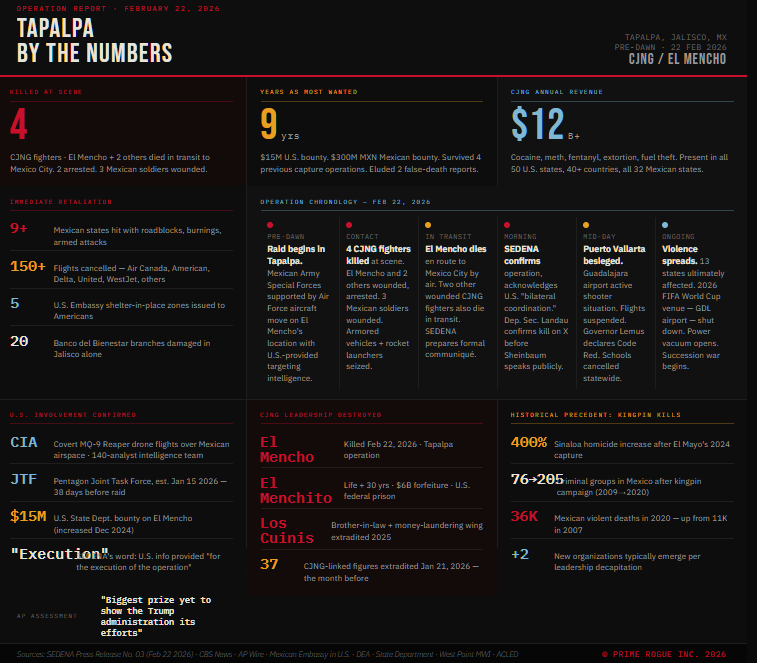
It began before dawn on Sunday, February 22, 2026, in Tapalpa — a quiet mountain town roughly 150 kilometers south of Guadalajara. Mexican Army Special Forces, backed by Air Force aircraft and National Guard rapid-reaction units, moved on a location where El Mencho was believed to be hiding. Intelligence came from three Mexican agencies — military intelligence, the National Intelligence Center, and the Attorney General’s organized crime unit (FEMDO) — supplemented by what SEDENA carefully called “complementary information” from U.S. authorities.
The operation was planned as a capture mission, not an assassination. It went sideways fast. CJNG operatives opened fire on the Special Forces, who returned fire in self-defense. Four cartel members were killed at the scene. Three more, including El Mencho himself, were gravely wounded. Two cartel members were arrested. Three Mexican soldiers were wounded and evacuated to hospitals in Mexico City. Among the hardware seized: armored vehicles, rocket launchers Fortune capable of downing aircraft, and an arsenal of war-grade weaponry.
El Mencho and two other wounded CJNG fighters were loaded onto aircraft for the flight to Mexico City. All three died in transit. l SEDENA identified the deceased as Rubén “N” (alias Mencho) but noted that forensic authorities would formally confirm identity — standard procedure, though nobody in the Mexican security apparatus appeared to have serious doubts. The communiqué came from SEDENA rather than the Security Cabinet, an unusual move that analysts noted immediately.
Deputy Secretary of State Christopher Landau — the former U.S. Ambassador to Mexico, a man who knows the terrain — confirmed the death on X within hours, calling El Mencho “one of the bloodiest and most ruthless drug kingpins” and adding: “The good guys are stronger than the bad guys.” In a follow-up post, he said he was watching the retaliatory violence unfold “with great sadness and concern.”
What happened next was a textbook narco-retaliation, and it was enormous. Jalisco Governor Pablo Lemus Navarro declared Code Red — the state’s maximum security protocol — and ordered the suspension of public transportation, cancellation of all mass events, and the closure of every school in the state for Monday.
In Puerto Vallarta, a city that welcomed a record 6.3 million visitors last year, thick columns of black smoke rose from more than ten burning vehicles. Armed men on motorcycles fired shots. The Costco parking lot was ablaze. Gas stations and convenience stores burned. Access roads to the airport were blocked. All flights were suspended. Canadian tourist Jeff Willis described it as looking “like a warzone.”
At Guadalajara’s international airport — scheduled to host four matches of the 2026 FIFA World Cup in June — passengers fled through terminals amid reports of gunfire. People ducked behind check-in counters. The airport operator issued a surreal statement claiming operations were “normal” and blaming “hysteria among passengers.”
Blockades erupted across at least nine states, possibly thirteen. In Michoacán, 13 municipalities were affected. In Guanajuato, six municipalities saw fires at pharmacies and stores. In Tamaulipas, armed men carjacked motorists to build barricades and deployed tire spikes across highways. In Nayarit, nine municipalities were hit. Violence spread to Colima, Aguascalientes, Zacatecas, Guerrero, Baja California, Veracruz, Querétaro, and San Luis Potosí. Twenty Banco del Bienestar branches in Jalisco alone sustained damage.
Air Canada, United, American, Delta, Southwest, Alaska, WestJet, Porter, Air Transat, Flair, and Volaris all suspended or cancelled flights. Delta Flight DL-1992, a Boeing 737 en route from Atlanta to Guadalajara, was diverted to Austin, Texas after crossing the border. More than 150 flights were cancelled across Mexican airports over the weekend. The U.S. Embassy issued shelter-in-place orders covering Jalisco, Tamaulipas, Michoacán, Guerrero, and Nuevo León.
Vanda Felbab-Brown, one of the world’s leading experts on organized crime, summarized the situation with characteristic directness: “A tremendous amount of violence is going to happen.”
The U.S. defense official who spoke to CBS News chose words with precision: the U.S. military “played a role” via the Joint Interagency Task Force–Counter Cartel, which “regularly works with the Mexican military through U.S. Northern Command.” The official emphasized that “this was a Mexican military operation, so the success is theirs.” That framing is diplomatically necessary. It is also incomplete.
The JIATF-CC was established on January 15, 2026 — just 38 days before El Mencho’s death — under the command of Brigadier General Maurizio Calabrese, a 30-year ISR specialist. Its stated mission: “coordinate all U.S. government resources” to “identify, disrupt and dismantle cartel operations.” Approximately 10,000 active-duty troops were already mobilized for intelligence, surveillance, and reconnaissance support. This is not an advisory body. This is an operational infrastructure.
Then there are the drones. The CIA began flying unarmed MQ-9 Reapers inside Mexican airspace under Biden, ostensibly to locate fentanyl labs which Trump sought to label weapons-of-mass destruction. The Trump administration expanded the program dramatically. CNN reported in February 2025 that more than two dozen flights had been completed, with a team of 140 intelligence experts analyzing the footage. The New York Times reported that fentanyl labs emit chemical signatures detectable from the air — making persistent drone surveillance a devastatingly effective targeting tool. Mexico’s own Defense Secretary, General Ricardo Trevilla, confirmed the drone flights had led to at least two cartel leaders’ arrests and said Mexico “requested and approved” them.
But CNN also reported something that complicates that tidy narrative: the Trump administration notified Congress of the flights using a covert action notification — the kind “reserved for new or updated covert programs that the CIA intends either to conceal or deny.” You do not file a covert action notification for something that was politely requested by your partner government.
SEDENA’s exact words: U.S. information was provided “for the execution of this operation.” X Not for background research. Not for strategic planning. For the execution. In military doctrine, “execution” refers to the active phase — the moment the mission goes live. This language implies the United States provided real-time or near-real-time tactical intelligence: location data, surveillance feeds, targeting information that directly enabled Mexican forces to find and engage El Mencho at that specific location on that specific morning.
No official source has confirmed that CIA drone surveillance provided the specific targeting intelligence for Tapalpa within the kill chain. But the infrastructure was purpose-built for exactly this. The inference is strong; the plausible deniability is tissue-thin.
NBC News reported in November 2025 that the Trump administration had begun planning for a potential JSOC mission inside Mexico — one that would operate under Title 50 authority, the legal framework for intelligence community operations rather than military ones. Title 50 carries different oversight rules. It allows covert operations. It is the authority under which the CIA drone flights already operate.
The Associated Press, whose wire copy was carried by every major outlet in the country, framed the killing in a single devastating sentence: the operation gave Sheinbaum’s government “its biggest prize yet to show the Trump administration its efforts.” The AP also noted that Sheinbaum “has been under tremendous pressure to show results against drug trafficking” since Trump took office.
The timeline tells the story. On his first day back in office — January 20, 2025 — Trump signed Executive Order 14157 designating Mexican cartels as Foreign Terrorist Organizations. On February 1, he slapped 25% tariffs on all Mexican imports under IEEPA, citing fentanyl. On February 3, after a phone call with Sheinbaum, he paused the tariffs — but only after she committed to deploying 10,000 National Guard troops to the border. Trump called her “a wonderful woman.”
That established the transactional framework: security cooperation for tariff relief. Sheinbaum, to her credit or her desperation, delivered. Since October 2024, her government has seized 1.8 tons of fentanyl, destroyed nearly 1,900 clandestine laboratories, and arrested 41,000 people linked to organized crime. The Army alone seized 559 kilos of fentanyl in 2025 — 65% more than the previous year. In December 2024, the Navy pulled off the largest fentanyl seizure in Mexican history: 1.5 tons in a single haul.
Then came the extraditions. In February 2025: 29 cartel figures sent to the U.S., including Rafael Caro Quintero, wanted for the 1985 killing of DEA agent Enrique “Kiki” Camarena. In August 2025: 26 more. On January 21, 2026 — exactly one month before El Mencho’s death — 37 cartel members were loaded onto seven military aircraft and flown to cities across the United States. The largest batch yet. Total transferred under Sheinbaum: 92 people.
David Mora of the International Crisis Group framed the dynamic bluntly: “As the pressure increases, as demands from the White House dial up, [Mexico’s government] needs to resort to extraordinary measures. For the Trump administration and the Trump base, what is going to matter in the end is some wins that Trump can actually bring back and say, ‘Look, this is what I’m getting out of Mexico.'”
El Mencho’s death is the biggest win imaginable. It arrives two days after the Supreme Court struck down Trump’s IEEPA tariff authority, with the administration scrambling for replacement mechanisms. It arrives four months before the mandatory USMCA six-year review in July 2026 — negotiations that will determine the future of $1.7 trillion in trilateral trade and where U.S. Trade Representative Jamieson Greer has already warned that “a rubberstamp is not in the national interest.” And it arrives five weeks after Trump told Fox News: “We are going to start now hitting land with regard to the cartels. The cartels are running Mexico.”
The operation allows Sheinbaum to demonstrate she can handle her own security affairs — undermining the justification for direct U.S. military intervention she has categorically rejected. “Sovereignty and self-determination are neither optional nor negotiable,” she has said. Yet the sovereignty of an operation planned with CIA drone intelligence, supported by a Pentagon counter-cartel task force, and announced by the U.S. Deputy Secretary of State before the Mexican president herself said a word — that sovereignty is a complicated thing.
President Sheinbaum, who was in Coahuila at the time of the raid, declined to confirm or deny El Mencho’s death when pressed by reporters. “The Security Cabinet will provide the information,” she said. Later, on X, she posted a carefully generic tribute: “My recognition to the Mexican Army, National Guard, Armed Forces and Security Cabinet. We work every day for peace, security, justice and the well-being of Mexico.”
To understand what the United States helped kill in Tapalpa, you have to understand what the United States helped create. The pattern is older than CJNG. It is older than the Mérida Initiative. It begins with the Grupo Aeromóvil de Fuerzas Especiales — GAFE — Mexico’s Airborne Special Forces.
Between 1996 and 1999, approximately 500 GAFE operators received advanced training from the U.S. Army’s 7th Special Forces Group at Fort Bragg, North Carolina. The curriculum included unconventional warfare, counterinsurgency, urban combat, rapid deployment, ambush techniques, counter-surveillance, and what one former instructor described as “the art of intimidation.” GAFE also trained with French GIGN and Israeli Sayeret commandos. These were, by design, the most lethal soldiers Mexico had ever produced.
In 1997, a GAFE lieutenant named Arturo Guzmán Decena — codenamed Z-1 — defected to work as a bodyguard for Gulf Cartel boss Osiel Cárdenas Guillén. He brought roughly 34 fellow GAFE deserters with him. They became Los Zetas — for over a decade, the most feared criminal organization in the Western Hemisphere. They brought their U.S.-funded training with them: military tactics, encrypted communications, intelligence tradecraft. They built training camps modeled on GAFE facilities. They recruited Guatemalan Kaibiles, corrupt police, even U.S. Army soldiers. By the early 2010s, Los Zetas controlled 11 Mexican states.
Seth Harp, whose 2025 book The Fort Bragg Cartel became an instant bestseller, has tracked at least 14 cases of Fort Bragg-trained soldiers arrested, apprehended, or killed while trafficking drugs in conjunction with Mexican cartels. “Trump says he wants to deploy military forces to Mexico to crack down on drug cartels,” Harp told Democracy Now. “But I think he should look closer to home.”
In 2007, the United States and Mexico launched the Mérida Initiative — a security assistance package that eventually exceeded $3.6 billion in total appropriations. It provided Black Hawk helicopters, surveillance equipment, police training, judicial reform programs, and — most consequentially — a strategic framework built around the “kingpin strategy”: identify and eliminate cartel leadership, one boss at a time.
The kingpin strategy was the brainchild of Robert Bonner, a former federal judge appointed DEA Administrator in 1990. His assumption was elegant and wrong: that cartels were hierarchical organizations that could be decapitated. Remove the head, the body dies.
Here is what actually happened. Between 2006 and 2020, the number of active criminal organizations in Mexico exploded from 76 to more than 200. The International Crisis Group has counted 543 distinct armed groups operating across the country since 2009. Under President Peña Nieto, Mexican authorities captured or killed 110 of 122 targeted kingpins. Violence did not decrease. It metastasized. Mexico went from fewer than 11,000 murders in 2007 to more than 36,000 violent deaths in 2020.
CJNG was born directly from this process. In 2009 and 2010, Mérida-funded operations led to the arrests of Milenio Cartel leaders Óscar and Juan Carlos Nava Valencia. Then on July 29, 2010, Mexican soldiers killed Sinaloa Cartel underboss Ignacio “Nacho” Coronel, who had been the Milenio Cartel’s patron. The Milenio Cartel shattered. Out of the wreckage, El Mencho — a former avocado farmer, former California drug convict, former small-town police officer — seized power, co-founded CJNG, and began building the empire that would rival the Sinaloa Cartel itself.
The pattern is not an accident. It is the pattern. American money and training build capacity. That capacity fragments or defects. New, more violent organizations emerge from the rubble. American money and training are deployed against the new organizations. The cycle repeats. As Foreign Affairs put it in 2025: “Mexico’s 2006 ‘kingpin strategy,’ which targeted cartel leaders, actually increased violence.”
Nemesio Oseguera Cervantes was born on July 17, 1966, in Naranjo de Chila, a village near Aguililla, Michoacán — deep in the avocado country of Mexico’s Tierra Caliente. He dropped out of school around age 10. By 12, he was running a marijuana plantation for the Valencia family. By 14, he was guarding crops.
He migrated illegally to the United States in the 1980s, settling in the San Francisco Bay Area. He was arrested in 1986 for stolen property and a loaded gun. Arrested again in 1989 for selling narcotics. Deported. Returned. Arrested in Sacramento in 1992. Convicted in 1994 of conspiracy to distribute heroin in federal court. Served roughly three years at a federal prison in Texas. Deported again.
Back in Mexico, he briefly joined local police forces in Jalisco — possibly laying the groundwork for future operations. Then he went full-time with the Milenio Cartel, starting as an assassin and bodyguard. When the Milenio leadership was systematically dismantled by the very forces the United States helped train and equip, El Mencho filled the void.
The cartel he built became the most geographically expansive criminal organization in Mexican history. By 2025, CJNG had a presence in all 32 Mexican federal entities — the first cartel to achieve that. The DEA’s National Drug Threat Assessment confirmed CJNG operates in all 50 U.S. states, competing head-to-head with the Sinaloa Cartel. The organization expanded into more than 40 countries across the Americas, Europe, Asia, and Australia.
CJNG’s estimated annual revenue is staggering: upward of $8 billion from cocaine and $4.6 billion from methamphetamine, with additional billions from fentanyl trafficking, fuel theft from Pemex pipelines, extortion, human smuggling, timeshare fraud, and illegal mining. When El Mencho’s son “El Menchito” was sentenced to life plus 30 years in March 2025, the court ordered him to forfeit $6 billion in trafficking proceeds.
But what truly set CJNG apart was its military capability. On May 1, 2015, during an operation to capture El Mencho, CJNG fighters fired six RPG rounds at Mexican military helicopters, downing one and killing nine soldiers and police officers — the first confirmed aircraft shootdown by organized crime in the history of Mexico’s drug war. Troops found military uniforms bearing insignia reading “CJNG Special Forces High Command” with five embedded stars.
CJNG pioneered cartel drone warfare. Beginning in 2017, the cartel deployed quadcopters armed with IEDs — available commercially for $229 on Amazon, retrofitted into weapons. By 2020, CJNG had a dedicated “Droneros” unit with custom patches and military-style organization. Their drones delivered C4 explosives, hand grenades, and in April 2024, chemical agents that caused respiratory distress in Michoacán. They deployed FPV kamikaze drones. They buried land mines on roads to disable army armored vehicles. They welded anti-drone “cope cages” onto their narco-tanks — a sophistication previously seen only in the Russia-Ukraine war.
The Trump administration designated it a Foreign Terrorist Organization on February 20, 2025. Secretary of State Marco Rubio’s determination cited CJNG’s “attacks on Mexican military and police with military-grade weaponry, the use of drones to drop explosives on Mexican law enforcement, and assassinations or attempted assassinations of Mexican officials.” In December 2025, Trump signed a further executive order designating fentanyl itself as a weapon of mass destruction.
We do not have to speculate about what happens when you kill or capture a cartel kingpin. We have the data. It is unambiguous.
When El Mayo Zambada — the last of the Sinaloa Cartel’s founding generation — was kidnapped by El Chapo’s son and delivered to the FBI in July 2024, the result was the most devastating urban cartel war in modern Mexican history. Homicides in Sinaloa rose more than 400%. In the sixteen months since, more than 2,400 people have been killed and 2,900 reported disappeared across the state. At least 1,763 families were displaced. Fifty rural communities became ghost towns. Thirty thousand jobs evaporated in Culiacán. Schools closed. A professional football club relocated 1,500 kilometers away. Clandestine crematoriums were discovered. Eleven thousand soldiers with armored vehicles and aircraft could not contain it.
This is not an anomaly. It is the rule. When Félix Gallardo was arrested in 1989, the entire Mexican drug trade splintered into the Tijuana and Sinaloa cartels. When Osiel Cárdenas was captured in 2003, the Gulf Cartel and Los Zetas went to war across northeastern Mexico. When Heriberto Lazcano — Z-3, the Zetas’ supreme leader — was killed in 2012, the organization fragmented into at least three major factions that continue generating extreme violence today. When Ignacio Coronel was killed in 2010, the Milenio Cartel split — and CJNG was born.
The academic literature is overwhelming. Calderón et al., writing in the Journal of Health Economics in 2018, found that “kingpin captures cause large and sustained increases to the homicide rate in the municipality of capture and smaller but significant effects on other municipalities where the kingpin’s organization has a presence.” Jane Esberg’s research through West Point’s Modern War Institute documented the proliferation from 76 to over 200 criminal groups. The Royal United Services Institute noted dryly that “perceiving the kingpin strategy as a success is predicated on the acceptance that the subsequent fragmentation and outbreaks of violence are somehow unrelated.”
Rex Rivolo of the Institute for Defense Analysis analyzed the data after Pablo Escobar’s death in 1993 and found something remarkable: cocaine prices on U.S. streets actually dropped after Escobar was killed — indicating more supply, not less. The labs did not stop because the boss was dead. They never do.
CJNG’s succession crisis is uniquely severe because the family pipeline has been almost entirely destroyed. El Menchito, El Mencho’s son and natural heir — the man who led CJNG for nearly seven years — is serving life plus 30 years in a U.S. federal prison. El Mencho’s brother Abraham was recaptured in February 2025. His brother Antonio was extradited to the U.S. His brother-in-law Abigael González Valencia, head of the Los Cuinis money-laundering empire, was extradited in August 2025. Two more brothers-in-law received sentences of life and 30 years respectively. El Mencho’s wife Rosalinda was released from prison in February 2025 but has no operational capacity.
The remaining operational leadership — lieutenants like Audias Flores Silva (“El Jardinero”), who controls territories across multiple states, and Hugo Mendoza Gaytan (“El Sapo”) — are sanctioned and targeted. There is no clear next El Mencho.
The U.S. intelligence community’s own assessment acknowledges the risk. The ACLED research group warned explicitly: CJNG’s “personalized leadership and centralized structure further exposes the criminal group to fragmentation, should its top leadership be dismantled — which could result in additional violence and expose civilians.” The U.S. Treasury noted that “Oseguera’s unique leadership style has allowed CJNG to function like a franchise business” — a franchise that just lost its founder, with no franchise manual for what comes next.
CJNG has already shown signs of fracturing before today. In 2022, a unit called Los Mezcales broke away in Colima and allied with the Sinaloa Cartel; violence in the state doubled. Co-founder Érick Valencia Salazar split off to form the Nuevo Plaza Cartel before being captured. In May 2022, InSight Crime reported that rumors of El Mencho’s poor health were “accelerating break-ups and infighting.”
Now the health rumors are settled. CJNG operates across more Mexican states than the Sinaloa Cartel did when its civil war began. It has at least 37 affiliated criminal groups that could splinter. If the Sinaloa parallel holds — and every precedent says it will — the violence will not be contained to Jalisco.
There is a word for what the United States did in Tapalpa, and the word is not “cooperation.” Cooperation is intelligence sharing through diplomatic channels. Cooperation is joint training exercises. What happened on February 22, 2026 involved a Pentagon task force created five weeks earlier with the explicit mission of dismantling cartel operations, a CIA drone program operating under covert action authority inside another country’s airspace, and tactical intelligence provided — per Mexico’s own Defense Secretariat — “for the execution of the operation.”
President Sheinbaum has said, directly to Trump: “Our territory is inviolable. Our sovereignty is inviolable.” She has rejected offers of U.S. troops on Mexican soil. She has insisted that Mexico’s security decisions are sovereign decisions. And yet. The intelligence architecture that made Tapalpa possible was American. The task force that “played a role” was American. The bounty on El Mencho’s head — $15 million — was American. The FTO designation that provided the legal framework was American. The deputy secretary of state confirmed the kill before the Mexican president acknowledged it.
Three Democratic lawmakers have introduced the “No Unauthorized War in Mexico Act” to prohibit military force against Mexico without Congressional authorization. NBC News reported in November 2025 that the Trump administration had begun planning a JSOC mission inside Mexico under Title 50 — intelligence community authority — which carries different oversight requirements and allows covert operations. In August 2025, Trump signed a secret directive authorizing Pentagon use of military force against Latin American cartels on foreign soil. Sixty-four people have already been killed in U.S. military strikes against suspected drug boats near Venezuela.
The trajectory is clear. Trump told Fox News in January: “We’ve knocked out 97% of the drugs coming in by water. And we are going to start now hitting land, with regard to the cartels.” Tapalpa may be the proof of concept.
The fundamental question is not whether El Mencho deserved what happened to him. He oversaw an organization responsible for incalculable suffering across two continents. The $15 million bounty existed for a reason. The question is what the United States is building — and what it will become. The Mérida Initiative built capacity that became Los Zetas. The kingpin strategy created the vacuum that became CJNG. The counter-cartel infrastructure being assembled right now — JIATF-CC, CIA Reapers, Title 50 authorities, FTO designations — will shape whatever comes next.
And whatever comes next, if history is any guide, will be worse. Not because the people running these programs are incompetent. Because the logic of the system produces the outcomes it produces. You train the soldiers, they defect. You kill the kingpin, the organization fragments. The fragments fight. The violence multiplies. New organizations fill the vacuum. You train new soldiers to fight the new organizations.
Claudia Sheinbaum — who has herself criticized the kingpin strategy — just executed the biggest kingpin operation in a decade. She did it with American intelligence, under American pressure, to buy relief from American tariffs, four months before Americans will decide the future of the trade agreement that keeps her economy alive.
The monster is dead. Long live whatever comes next.
 The General Who Fell From the Sky: Al-Haddad, Libya’s Perpetual Chaos, and the Ghosts of Wattiya
 The Detour Doctrine: Why Canada and Mexico Are Replacing U.S. Trade Infrastructure
 The Fed Versus the MAGA State: What Happens If Trump Fires Jerome Powell?
 The M10 Booker Is Dead: Why the U.S. Army Killed Its ‘Light Tank’ in the Age of Near-Peer War